Play Water Sort Puzzle
Pour the colours between tubes until each tube holds just one.Water Sort hands you a row of test tubes, each part-filled with coloured liquid stacked in layers. The colours are jumbled between the tubes, and your job is to pour them from tube to tube until every tube holds a single colour and the rest stand empty. It is one of the calmest puzzles to look at and one of the easiest to pick up. The one rule that shapes everything is how a pour works: you can only tip a colour onto the same colour or into an empty tube, and it never overflows the top. So you cannot just dump liquid anywhere. Free space and matching tops are your currency, and a careless pour can bury a colour you needed. Good players keep a spare tube open, plan a few pours ahead, and gather each colour together before they start pulling the next one apart.
You can play Water Sort free in your browser here - a row of tubes part-filled with stacked colour segments. It is rated relaxing but tricky, and every deal is generated by reverse moves, so it is always solvable. Choose from Easy (6 colours), Medium (8 colours) or Hard (10 colours). Your best times and solve counts save automatically, and you can take on the daily challenge whenever you like.
How Water Sort works
In short: Pour the colours between tubes until each tube holds just one. The play area is a row of tubes part-filled with stacked colour segments, it is rated relaxing but tricky, and every deal is generated by reverse moves, so it is always solvable.
Key facts about Water Sort
| Objective | Sort the colours so that each tube ends up holding just one colour, filled to the level it started at, with any leftover tubes standing empty. |
|---|---|
| Play area | A row of tubes part-filled with stacked colour segments |
| Difficulty | Relaxing but tricky |
| Solvability | Every deal is generated by reverse moves, so it is always solvable |
| Board options | Easy (6 colours), Medium (8 colours), Hard (10 colours) |
| Category | Color puzzle |
Learn Water Sort in five steps
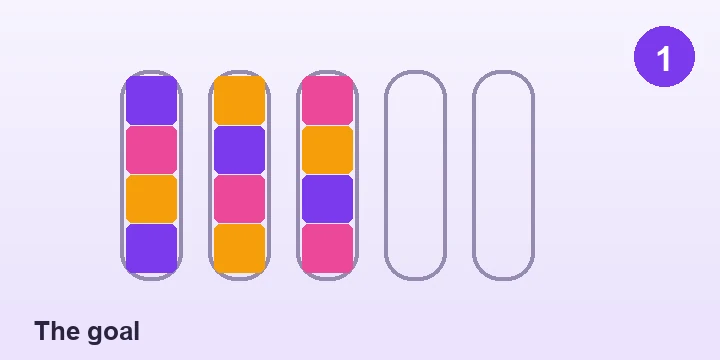
The goal
Sort the colours so that each tube ends up holding just one colour, filled to the level it started at, with any leftover tubes standing empty.
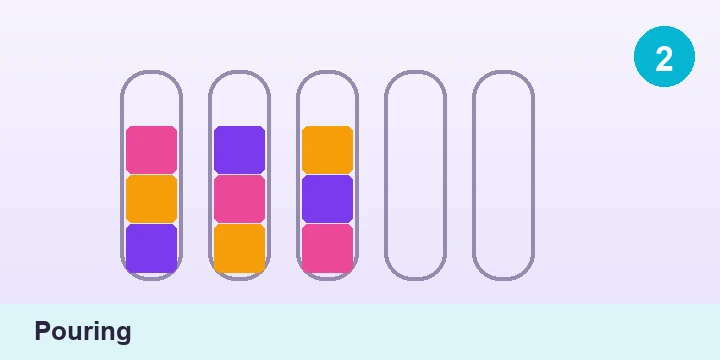
Pouring
Tap a tube to lift it, then tap another to pour. The top colour of the first tube flows across, and it moves as a group when several of that colour are stacked together.
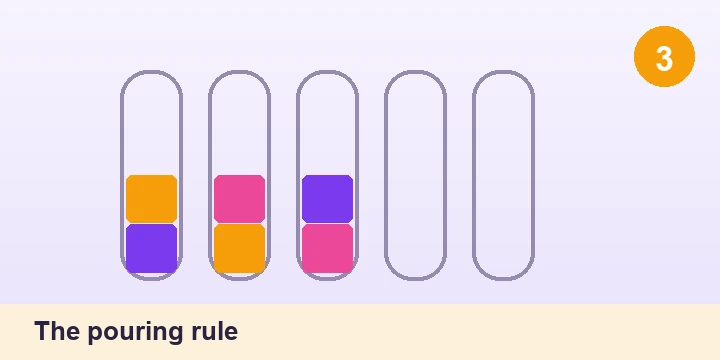
The pouring rule
Liquid only pours onto an empty tube or onto the very same colour already on top, and never past the top of the receiving tube. If those conditions fail, the pour simply will not happen.
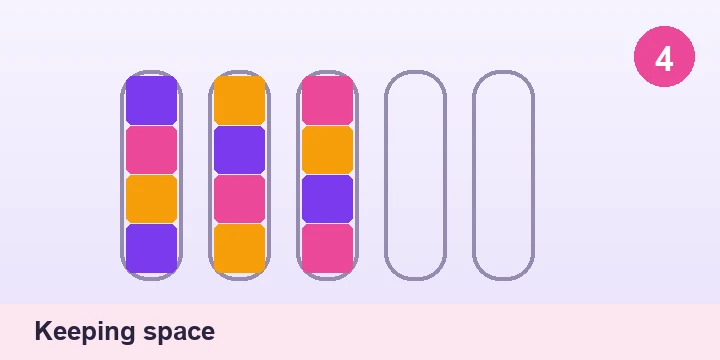
Keeping space
An empty tube is your most useful tool. Use it to park a colour for a moment so you can reach the ones trapped beneath it, then pour that colour back where it belongs.
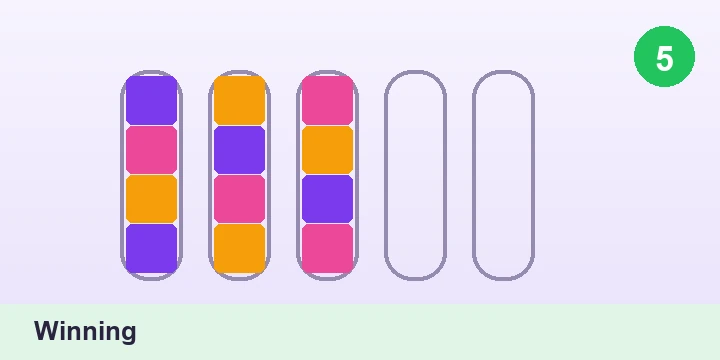
Winning
The deal is solved when every colour is gathered into its own tube. If you run out of legal pours, reset and try a different order of moves.
Where Water Sort came from
Water Sort became a mobile hit around 2019 and 2020, when versions titled Water Sort Puzzle and the near-identical Ball Sort Puzzle spread rapidly through app stores. Their soothing colours and one-finger controls made them a natural fit for short breaks, and clips of tricky deals circulated widely on social media.
The mechanic itself is much older than the trend. Sorting objects between a few limited containers is a classic idea in both recreational puzzles and computer science, where arranging items using a small number of stacks and a spare slot is a well-worn exercise. Water Sort simply gave that abstract idea a friendly, liquid-filled skin.
Because a fresh deal can be generated by scrambling a solved board, the format is endlessly replayable and always fair, which is a large part of why it stayed popular long after the first viral wave passed.
Tips to solve Water Sort faster
💡 Best move: Best move: keep at least one tube empty whenever you can, because a free tube is the space you need to unbury a trapped colour and undo a jam.
- Pour onto a matching colour before you pour into an empty tube, since filling your empties too early wastes the very space that lets you sort.
- Look at what sits underneath before you tip a tube, because a pour that exposes a colour you can immediately place is worth far more than one that buries something useful.
- Finish gathering a colour completely before you start splitting another apart, so half-sorted tubes do not pile up and block each other.
- Only pour a colour when the whole group can move at once, or when the move clearly opens up progress, since single dribbles that strand a colour are usually a trap.
- If you stall, look for two tubes whose top colours match; joining them often frees a slot that unlocks the rest of the board.
Sharper tactics for Water Sort
- Read the board as a set of buried colours. The colour with the most layers sitting on top of it is your real bottleneck, so aim your early pours at digging it out.
- Treat empty tubes as a budget you can overspend. Filling one too soon can leave you with no legal pour at all, a soft lock that only a reset will cure.
- Plan pours in pairs. A single move often looks pointless until you see that it sets up a second pour which consolidates two half-tubes into one.
- Prefer moves that increase the number of matching tops on the board, because every same-colour top is a future landing spot that keeps your options open.
- Near the end, count the colours that still need a home against the empty tubes you have left. If they do not balance, backtrack now rather than pour yourself into a dead end.
Mistakes that trip people up
- Filling your empty tubes too early - keep at least one tube free as working space, because empties are what let you unbury a trapped colour.
- Pouring without checking what sits underneath - a pour that buries a colour you needed costs you, so dig out useful colours rather than covering them.
- Splitting a new colour before finishing the last - gather each colour completely first so half-sorted tubes do not pile up and jam the board.
- Pouring a colour onto a mismatched top - liquid only stacks on the same colour or into an empty tube, so line up matching tops before you tip.
Ways to play Water Sort
Water Sort
The original tube-and-liquid version, where matching colours pour together and empty tubes give you the room you need to sort.
Ball Sort
The same puzzle with stacked coloured balls instead of liquid; only the top ball of each tube can move, but the sorting logic is identical.
More colours and tubes
Larger deals add extra colours and tubes, deepening the buried stacks and forcing you to plan more pours in advance.
Limited-move challenges
Timed or move-capped versions push the calm base game toward a race, rewarding the shortest sorting sequence rather than a leisurely solve.
Water Sort questions, answered
What is the goal of Water Sort?
You win when every tube holds only one colour and any extra tubes are empty. You get there by pouring the top colour of one tube onto a matching colour in another, or into an empty tube, until all the mixed-up layers are neatly sorted.
What are the pouring rules?
A colour can only be poured onto an empty tube or on top of the same colour, and only if there is room. Several units of the same colour stacked together pour as one group. If none of those conditions are met, the tube will not pour.
Is every Water Sort puzzle solvable?
Yes. Each deal is built by starting from a fully sorted set of tubes and running the pours backwards to scramble it, so a valid solution is guaranteed. If you get stuck, it is the move order that needs changing, not the deal.
Why can't I pour a colour?
A pour is blocked if the receiving tube is full, or if its top colour is different from the one you are pouring. You can only stack like on like or fill an empty tube, so check the top colours of both tubes before you tip.
What is the best strategy?
Keep an empty tube free whenever possible, dig out the most deeply buried colour first, and finish gathering one colour before you disturb another. Empty space is the resource that makes every other move possible.
How many colours are in each mode?
The easy deal uses six colours, medium uses eight, and hard uses ten. More colours mean more tubes and more layers to untangle, so the harder modes reward planning several pours ahead.
Where did Water Sort come from?
It spread as a viral mobile puzzle around 2019 and 2020 under names like Water Sort Puzzle and the closely related Ball Sort Puzzle. The idea descends from much older sorting and stack puzzles, dressed up here in tidy, colourful tubes.
Still curious about Water Sort? Browse the full puzzle FAQ, look up a term such as color puzzle in the puzzle glossary, or compare Water Sort with the other games in the rules for every puzzle.
Last updated .