Play Lights Out Puzzle
Press cells to flip lights and their neighbours until the whole grid is dark.Lights Out is a pure switching puzzle. The board starts with some cells glowing and some dark, and every time you press a cell it flips - on becomes off, off becomes on - along with the cells directly above, below, left and right of it. Your only job is to turn every light off. It sounds like whack-a-mole, but the cross-shaped ripple of each press means the moves tangle together in ways that reward thinking, not tapping. The elegant secret is that the order of your presses never matters and pressing the same cell twice cancels out, so a solution is really just a set of cells to press exactly once. That turns Lights Out into a beautiful little problem in logic: expert players solve the top rows freely, then use the pattern left along the bottom edge to work out precisely which cells in the very first row they should have pressed - a technique called light chasing.
You can play Lights Out free in your browser here - a grid of lit and unlit cells where each press toggles a plus-shaped cluster. It is rated a true logic puzzle, and every puzzle we generate has a guaranteed solution. Choose from 3×3 or 5×5 (classic). Your best times and solve counts save automatically, and you can take on the daily challenge or start a multiplayer race whenever you like.
How Lights Out works
In short: Press cells to flip lights and their neighbours until the whole grid is dark. The play area is a grid of lit and unlit cells where each press toggles a plus-shaped cluster, it is rated a true logic puzzle, and every puzzle we generate has a guaranteed solution.
Key facts about Lights Out
| Objective | Switch off every light on the board. A cell is solved only when the entire grid is completely dark at the same moment. |
|---|---|
| Play area | A grid of lit and unlit cells where each press toggles a plus-shaped cluster |
| Difficulty | A true logic puzzle |
| Solvability | Every puzzle we generate has a guaranteed solution |
| Board options | 3×3, 5×5 (classic) |
| Category | Logic puzzle |
Learn Lights Out in five steps
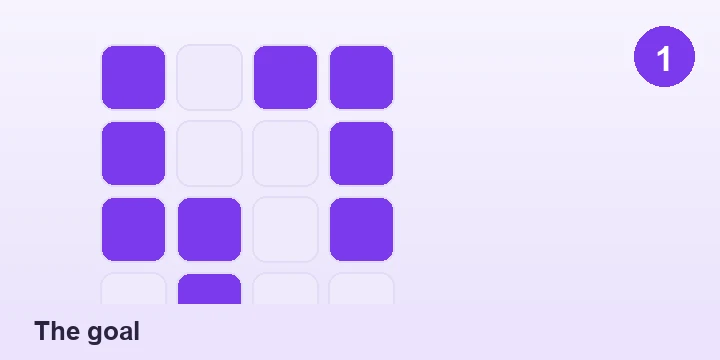
The goal
Switch off every light on the board. A cell is solved only when the entire grid is completely dark at the same moment.
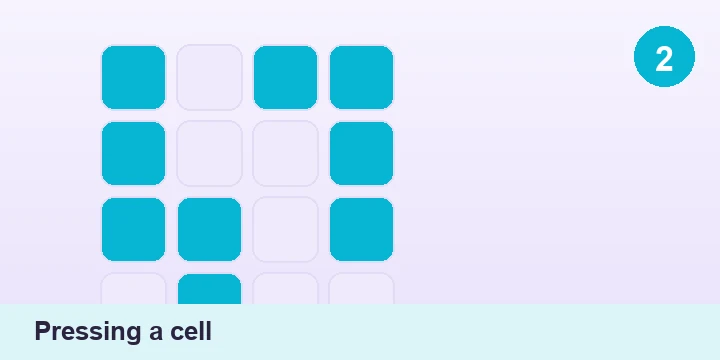
Pressing a cell
Click or tap any cell to toggle it and its four orthogonal neighbours between lit and unlit. Corners and edges simply toggle fewer neighbours.
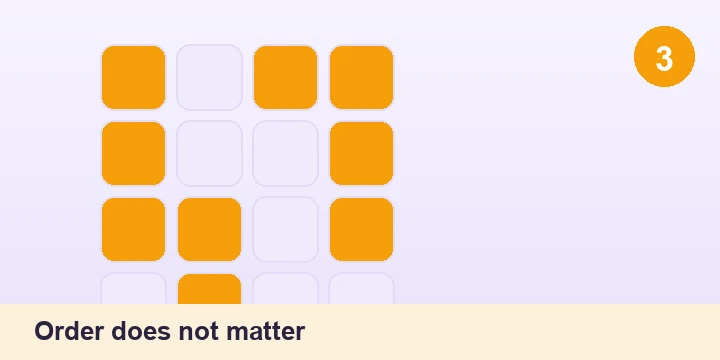
Order does not matter
You can make your presses in any sequence and reach the same result, and pressing a cell twice undoes it - so the whole puzzle is about which cells to press, not when.
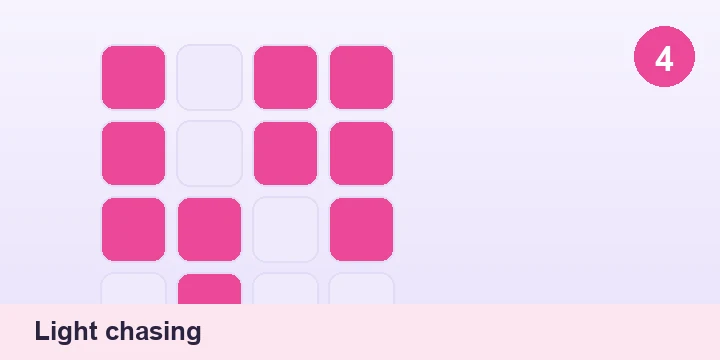
Light chasing
Work top to bottom: for each row, press the cells directly beneath any light still on above you. This 'chases' the lit cells downward until only the bottom row is left to reason about.
Winning
The puzzle ends the instant the last light goes dark. Fewer presses makes for a cleaner solve, and the timer and move count track how efficiently you cleared it.
Where Lights Out came from
Lights Out was released as a handheld electronic game by Tiger Electronics in 1995. Its glowing five-by-five grid of buttons, each press rippling out to its neighbours, made it an instant pocket favourite and a staple of the era's beep-and-blink toys.
The concept was not entirely new - earlier games such as Merlin in the late 1970s and a puzzle called XL-25 used similar neighbour-toggling ideas - but Tiger's version fixed the format that everyone now recognises and gave it its memorable name.
Beyond the toy aisle, Lights Out became a beloved teaching tool. Mathematicians adopted it as a hands-on introduction to solving systems of equations over binary arithmetic, and it remains a classic example in linear algebra courses, proving that a children's gadget could hide a genuinely elegant piece of mathematics.
Tips to solve Lights Out faster
💡 Best move: Use light chasing as your backbone - sweep from the top row down, always pressing the cell below a light that is still on, until every lit cell has been pushed to the bottom edge.
- Whatever pattern is left glowing along the bottom row after a full chase tells you exactly which cells in the top row you needed to press first; restart, press those, and chase again.
- Remember that pressing a cell twice is wasted effort, so if you find yourself toggling the same square repeatedly you have lost the thread - step back and re-chase.
- On the 3×3 board you can often just reason it out directly, which makes it the perfect place to learn how the cross-shaped toggle behaves.
- Corners and edges are powerful because they toggle fewer cells; use them to fix a single stubborn light without disturbing three of its neighbours.
- Plan the whole chase in your head before you start pressing, since the fewer total presses you make, the better your score.
Sharper tactics for Lights Out
- Memorise the handful of bottom-row patterns and their matching top-row presses. On the classic 5×5 there are only a few cases, and knowing them turns any solvable board into a two-pass solve.
- Think of each press as a switch that is either used or unused, never twice - a solution is a subset of the board, which is why two different-looking sequences can be the same real answer.
- If a full chase leaves a bottom row that matches none of the fixable patterns, you either mis-chased or you are on a board that needs a specific top-row seed - re-run the chase carefully.
- The 5×5 has more than one valid solution for many start states; aim for the one with the fewest presses rather than the first that works.
- Practise reading the board as rows of on/off states rather than individual lights - the pattern along an edge carries all the information you need for the next move.
Mistakes that trip people up
- Tapping lights hoping they cancel out - use light chasing, pressing the cell below each lit cell row by row, instead of guessing.
- Pressing the same cell more than once - an even number of presses does nothing, so if you are toggling a square repeatedly you have lost the thread.
- Ignoring the bottom row after a chase - the pattern left glowing there tells you exactly which top-row cells to press first, so read it and restart.
- Forgetting corners toggle fewer lights - use a corner or edge press to fix one stubborn light without knocking out its neighbours.
Ways to play Lights Out
Classic 5×5
The original Tiger Electronics layout, where light chasing and a small set of bottom-row patterns solve any board.
Mini 3×3
A nine-cell version that is easy enough to solve by pure logic, perfect for understanding how the toggle ripple works.
Lights Out 2000
A sequel format where cells cycle through more than two states, adding an extra layer to the switching puzzle.
Wrap-around boards
Variants where the toggle ripple wraps from one edge to the opposite side, changing which presses fix a given light.
Lights Out questions, answered
Is every Lights Out puzzle solvable?
Not every random pattern of lights on a physical Lights Out can be turned off, but every board Puzzle.now generates is built to be solvable. We create each puzzle by starting from a dark grid and pressing cells, so a valid solution is always guaranteed to exist.
What is light chasing?
Light chasing is the standard solving method: you work down the board row by row, and for every light still on in the row above, you press the cell directly below it. This pushes all the lit cells to the bottom row, where a small amount of pattern-matching finishes the job.
Does it matter what order I press the cells?
No, and that is the puzzle's cleverest property. You can press your chosen cells in any order and reach the identical result, and pressing a cell an even number of times is the same as never pressing it. A solution is simply the set of cells that need one press.
Why does pressing a corner feel different?
A corner cell only has two neighbours, so pressing it toggles three lights instead of five. Edge cells toggle four. That makes corners and edges useful for surgically fixing a lone stubborn light without knocking out cells you already cleared.
How many solutions does a board have?
On the 5×5 classic board, many starting patterns have more than one valid solution, while some have exactly one. When several exist, the interesting goal becomes finding the solution that uses the fewest presses.
Is Lights Out based on real maths?
Yes. Lights Out is a favourite example in linear algebra over the two-element field, because each solution corresponds to solving a system of on/off equations. You do not need any of that to play, but it explains why light chasing always works.
What is a good board size to learn on?
The 3×3 board is the best teacher because you can often solve it by pure reasoning and clearly see how each press ripples outward. Once the cross-shaped toggle feels natural, the 5×5 classic is where the light-chasing technique really pays off.
Still curious about Lights Out? Browse the full puzzle FAQ, look up a term such as logic puzzle in the puzzle glossary, or compare Lights Out with the other games in the rules for every puzzle.
Last updated .