Play Rush Hour Puzzle
Slide the cars and trucks out of the way to drive the red car to the exit.Rush Hour is a sliding puzzle set in a gridlocked car park. A six by six grid is jammed with cars, two cells long, and trucks, three cells long, all parked at different angles. One of them is your red car, and there is a single exit cut into the edge of the board. Your job is to slide the other vehicles out of its way and drive the red car straight out. The catch is that every vehicle moves only forwards and backwards along its own lane. A car facing left and right can only slide left and right, never turn, and it can only move into empty cells. So clearing a path for the red car means nudging a whole chain of vehicles in the right order, and the fun is untangling which one has to shift first before anything else can budge at all.
You can play Rush Hour free in your browser here - a 6 by 6 grid gridlocked with cars and trucks. It is rated a sliding logic jam, and every jam is solvable - reset and retry as often as you like. Choose from Easy, Medium or Hard. Your best times and solve counts save automatically, and you can take on the daily challenge whenever you like.
How Rush Hour works
In short: Slide the cars and trucks out of the way to drive the red car to the exit. The play area is a 6 by 6 grid gridlocked with cars and trucks, it is rated a sliding logic jam, and every jam is solvable - reset and retry as often as you like.
Key facts about Rush Hour
| Objective | Slide the red car along its row and out through the exit on the edge of the board. The puzzle is won the instant the red car leaves the grid. |
|---|---|
| Play area | A 6 by 6 grid gridlocked with cars and trucks |
| Difficulty | A sliding logic jam |
| Solvability | Every jam is solvable - reset and retry as often as you like |
| Board options | Easy, Medium, Hard |
| Category | Sliding puzzle |
Learn Rush Hour in five steps
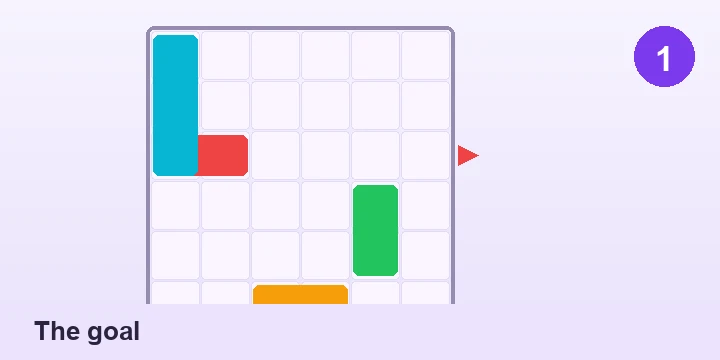
The goal
Slide the red car along its row and out through the exit on the edge of the board. The puzzle is won the instant the red car leaves the grid.
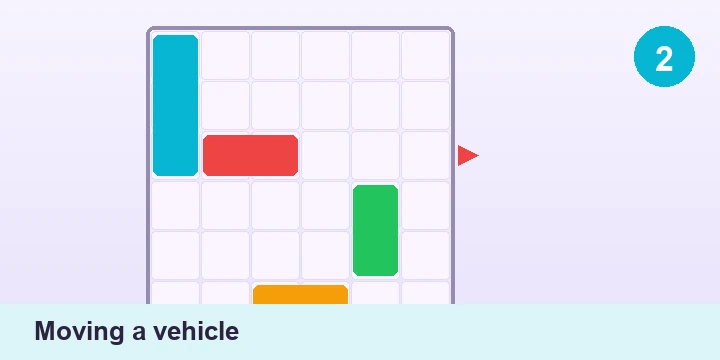
Moving a vehicle
Drag a car or truck forwards or backwards along the lane it is parked in. Vehicles never turn, so a horizontal one only slides left and right, and a vertical one only up and down.
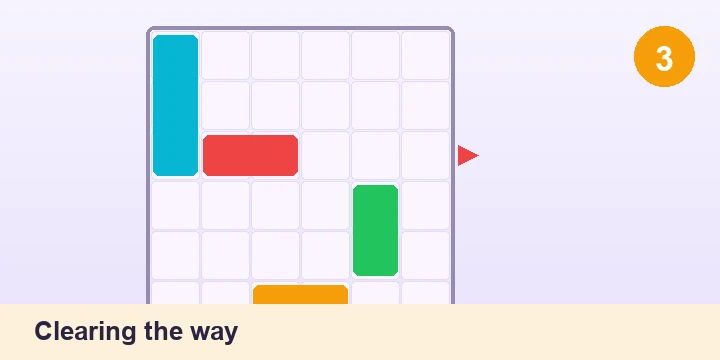
Clearing the way
Each vehicle can only move into empty cells, so freeing the red car's row usually means shifting several others out of it first, in the right sequence.
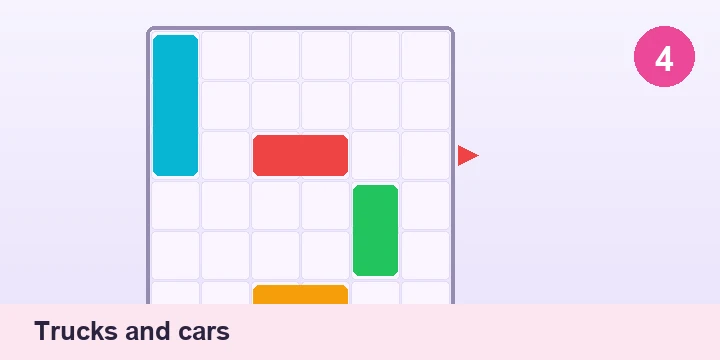
Trucks and cars
Cars take up two cells and trucks take up three, so trucks are harder to tuck out of the way and often decide how tight the whole jam really is.
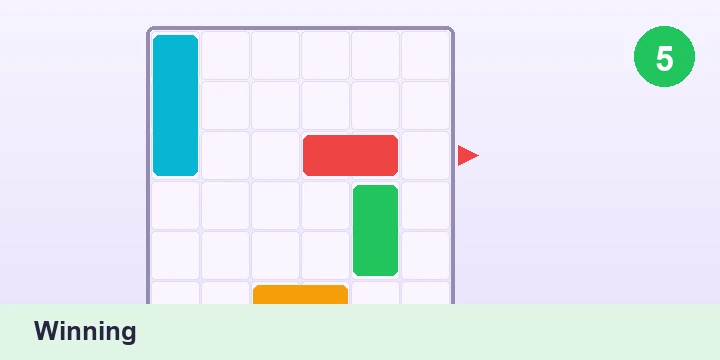
Winning
Get the red car to the exit to solve the jam. Every puzzle has a solution, so if you paint yourself into a corner you can reset and try a different order.
Where Rush Hour came from
Rush Hour was invented in the 1970s by Nob Yoshigahara, a celebrated Japanese puzzle designer known for his inventive mechanical puzzles. He built the sliding-traffic idea into a compact grid where one special car has to escape a jam of blocking vehicles.
The puzzle reached a global market in 1996, when the American company Binary Arts, later renamed ThinkFun, began producing it with numbered challenge cards ranging from beginner to expert. That graded set of set-up cards, each a separate puzzle on the same board, was a large part of its success.
Rush Hour went on to sell many millions of copies and win a place in puzzle collections worldwide. It has also drawn attention from mathematicians and computer scientists, who study sliding-block traffic puzzles like it as examples of surprisingly hard planning problems.
Tips to solve Rush Hour faster
💡 Best move: Best move: find the vehicles directly blocking the red car's row first, and work out where each one must go before you touch anything else.
- Solve backwards from the exit by asking what has to move for the red car to reach the edge, then what has to move to allow that, and so on down the chain.
- Respect the lanes, because a blocker can only slide along its own row or column, so check it actually has an empty cell to move into before you count on shifting it.
- Give the long trucks priority, since a three-cell truck needs a lot of clear space and often has only one place it can go, so build the rest of your plan around it.
- Avoid shuffling vehicles at random, because every move that does not help clear the red car's path is likely to clog a lane you will need later.
- When a jam feels impossible, look for the one vehicle everything else is waiting on, move it first, and the rest of the tangle usually loosens.
Sharper tactics for Rush Hour
- Trace the dependency chain. Blocker A cannot move until B shifts, and B cannot shift until C does, so reading that chain to its end reveals the true first move, which is rarely the car nearest the exit.
- Count empty cells like a budget. With so little free space, every move either opens a lane you need or wastes room you will miss later, so spend those gaps deliberately.
- Watch for mutual blocks, where two vehicles each sit in the only space the other needs. Spotting these standoffs early tells you which one must take a detour through a third lane.
- The long trucks are the skeleton of the jam. Because they need three clear cells and can seldom move far, planning their few possible positions first constrains everything else into place.
- If a straightforward plan stalls, look for a move that seems to go the wrong way, since freeing the exit often requires first sliding a vehicle deeper into the board to open the lane another one needs.
Mistakes that trip people up
- Sliding cars at random - find the vehicles blocking the red car first and work out where each must go before you move anything.
- Forgetting vehicles stay in their lane - a car only slides along its own row or column, so check it has an empty cell before counting on it.
- Leaving the long trucks for last - a three-cell truck needs lots of space and has few options, so plan the jam around it first.
- Only ever pushing toward the exit - sometimes you must slide a vehicle deeper into the board to open the lane another one needs.
Ways to play Rush Hour
Classic 6 by 6
The standard board where cars, trucks and one red escapee are packed into a thirty-six cell grid with a single exit to reach.
Graded challenge cards
The traditional set-up decks that fix the starting jam, ranging from gentle beginner boards to expert tangles with long solutions.
Bigger boards and extra exits
Larger grids or added exits that raise the piece count and open new escape routes, deepening the planning required.
Themed traffic jams
Versions that reskin the vehicles as trains, boats or spaceships while keeping the exact slide-only-in-your-lane rule intact.
Rush Hour questions, answered
What is the goal of Rush Hour?
You have to drive the red car off the board through the single exit on the edge. To do that you slide all the other cars and trucks out of its path, since they are blocking the way. The puzzle is won the moment the red car escapes.
How do the vehicles move?
Every car and truck slides only forwards or backwards along the lane it is parked in, and only into empty cells. They never turn or change lanes, so a horizontal vehicle stays horizontal and a vertical one stays vertical for the whole puzzle.
Is every Rush Hour jam solvable?
Yes. Every jam offered here has a valid solution, so escape is always possible. You can, however, tangle yourself into a stuck position by moving pieces the wrong way, in which case a reset returns you to a solvable start.
What is the best way to start?
Look first at the vehicles directly blocking the red car, then work backwards to figure out what must move to clear them. Rush Hour rewards planning the chain of moves before you slide anything, rather than pushing cars around hopefully.
Why are the trucks so important?
Trucks are three cells long, so they need more clear space to move and usually have very few places they can go. Because they are the hardest pieces to reposition, they often dictate the order of the whole solution.
How do the difficulty levels differ?
Easier jams have fewer blocking vehicles and shorter solutions, so the path clears in a handful of moves. Harder jams pack the grid tighter and hide the answer behind a long chain of dependent moves that takes real planning to untangle.
Who invented Rush Hour?
The puzzle was invented by the Japanese designer Nob Yoshigahara in the 1970s. It was later brought to a worldwide audience by the company Binary Arts, now known as ThinkFun, which began selling it in 1996 and turned it into a bestselling puzzle.
Still curious about Rush Hour? Browse the full puzzle FAQ, look up a term such as sliding puzzle in the puzzle glossary, or compare Rush Hour with the other games in the rules for every puzzle.
Last updated .