Play Block Puzzle
Drag shaped blocks onto the grid and clear full rows and columns before you run out of room.Block Puzzle is the calm, grid-filling cousin of falling-block games. Instead of pieces dropping on a timer, you are handed three shapes at a time and drop them wherever they fit on an 8×8 board. Whenever a row or column is completely filled it clears, freeing up space. There is no clock and nothing falls - the only pressure is the room you have left. That relaxed surface hides a real optimisation puzzle. You must place all three offered pieces before the next three arrive, so a greedy placement that clears a line now can leave awkward gaps that strand a big block later. The best players keep the board open and flat, hoard empty space in a corner for the large shapes, and set up double or triple line clears that reset huge swathes of the grid at once.
You can play Block Puzzle free in your browser here - an 8×8 grid you fill by dragging in blocks; complete lines clear away. It is rated easy to start, endless to master, and an endless score chase - survive as long as your placements allow. Your best times and solve counts save automatically, and you can take on the daily challenge whenever you like.
How Blocks works
In short: Drag shaped blocks onto the grid and clear full rows and columns before you run out of room. The play area is an 8×8 grid you fill by dragging in blocks; complete lines clear away, it is rated easy to start, endless to master, and an endless score chase - survive as long as your placements allow.
Key facts about Blocks
| Objective | Keep placing blocks for as long as possible, scoring points for every cell you place and a bonus for every line you clear. The game ends only when no offered block fits anywhere. |
|---|---|
| Play area | An 8×8 grid you fill by dragging in blocks; complete lines clear away |
| Difficulty | Easy to start, endless to master |
| Solvability | An endless score chase - survive as long as your placements allow |
| Category | Blocks puzzle |
Learn Blocks in five steps
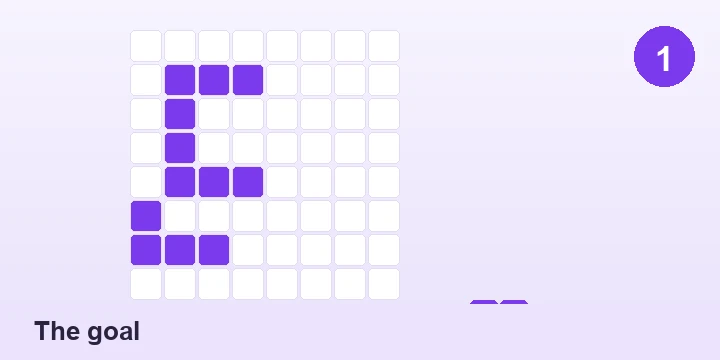
The goal
Keep placing blocks for as long as possible, scoring points for every cell you place and a bonus for every line you clear. The game ends only when no offered block fits anywhere.
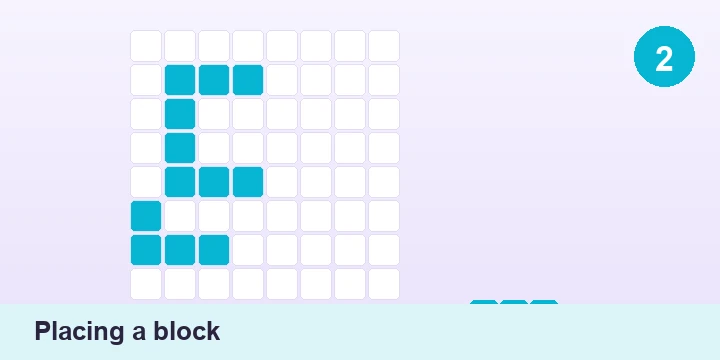
Placing a block
Drag one of the three offered shapes onto the grid. It drops wherever it fully fits on empty cells - blocks cannot be rotated, so plan around their given orientation.
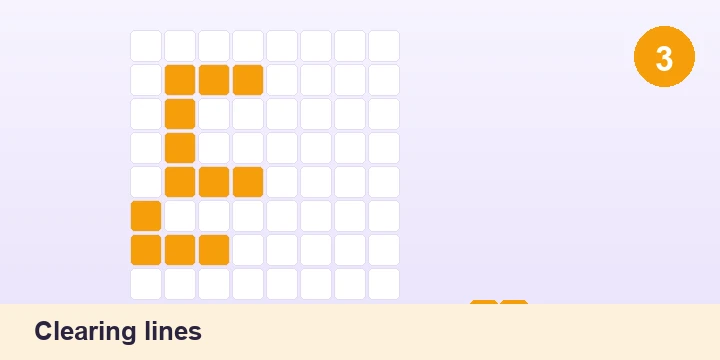
Clearing lines
Complete any full row or full column and it clears instantly, whether you filled it horizontally, vertically, or both at once for a combo.
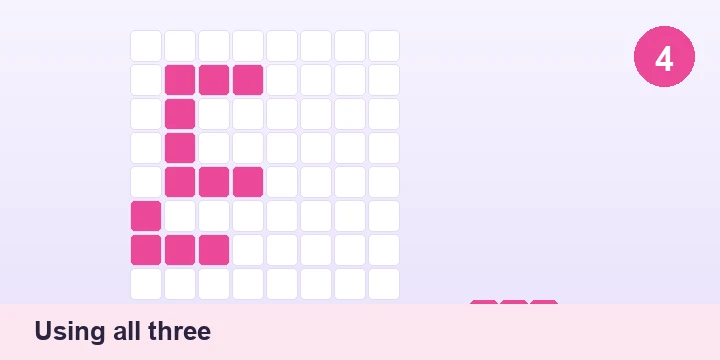
Using all three
You must place all three shapes in a set before a new set appears. If none of the remaining shapes can fit anywhere, the game is over.
Scoring
You earn points for the cells you place and larger rewards for clearing multiple lines together. A tidy board that survives longer always outscores a flashy early clear.
Where Blocks came from
Block Puzzle grows directly out of the falling-block tradition that began with Tetris, created in 1984 by the Soviet engineer Alexey Pajitnov. Tetris established the language of polyomino shapes sliding into a grid and vanishing lines that generations of games have spoken ever since.
Long before video games, wooden packing puzzles asked players to fit irregular blocks neatly into a tray, and the drag-to-place grid game inherits that tactile, spatial appeal. The modern touchscreen version strips away the clock and the rotation, leaving a purely spatial optimisation.
The format exploded on smartphones in the 2010s, where its untimed, one-more-set rhythm suited casual play perfectly. Under many names it became one of the most downloaded puzzle styles in app stores, prized for being instantly understandable yet genuinely hard to play well.
Tips to solve Blocks faster
💡 Best move: Keep the board as flat and open as you can - scattered single gaps are what kill a run, so favour placements that leave large connected empty areas rather than clearing a line at any cost.
- Reserve an open region for the big shapes. Always ask whether the awkward 3×3 or long bar could still be placed after your move; if not, put it down first.
- Set up combos by leaving a row and a column one cell short of full, then dropping a single piece that completes both at once for a double clear.
- Place all three offered pieces with the whole set in mind - sometimes the best first move is the one that guarantees the other two shapes will still fit.
- Build clears toward the edges and corners, where filling in around a piece is easier, and keep the centre of the board breathable.
- When space gets tight, prioritise clearing lines over chasing points; a cleared line buys you the room to keep playing, which is worth more than any single placement.
Sharper tactics for Blocks
- Treat empty space as your real resource. Count roughly how many cells you have free and refuse placements that fragment that space into pockets too small for the larger pieces.
- Learn which shapes are 'expensive' - the square and long bars need contiguous room - and always keep at least one region that could still accept the biggest possible next piece.
- Chain clears deliberately: a board arranged so that one placement completes two or three lines simultaneously both scores heavily and resets your available space in a single move.
- Avoid building tall isolated columns of filled cells; a nearly-full column that you cannot top off becomes dead weight that shrinks the usable board.
- Think one set ahead. Because you always place three pieces at once, the safest move now is the one that leaves the most flexible board for whatever three shapes arrive next.
Mistakes that trip people up
- Clearing a line at any cost - a greedy clear that fragments the board into single gaps strands your bigger pieces, so keep the space open and flat.
- Forgetting the big shapes - always leave one region large enough for the 3x3 or long bar, and place awkward pieces first while room exists.
- Placing pieces one at a time without a plan - you must fit all three offered shapes, so choose a first move that guarantees the other two still fit.
- Building tall isolated columns - a nearly full column you cannot top off becomes dead weight that shrinks the usable board.
Ways to play Blocks
Classic 8×8
The standard board where three fixed-orientation pieces at a time must be fitted and full lines clear - the format most players know.
Larger grids
Bigger boards such as 9×9 or 10×10 give more room to manoeuvre but demand longer-range planning to keep lines completing.
Wood block styles
Themed versions dress the blocks as carved wood or gems, sometimes adding gravity or colour-matching twists to the core placement game.
Timed and combo modes
Some versions add a clock or reward rapid consecutive clears, pushing the calm base game toward a faster, higher-pressure challenge.
Blocks questions, answered
How do you win Block Puzzle?
There is no final win screen - Block Puzzle is an endless score chase. The aim is to survive as long as possible and rack up the highest score before you reach a position where none of the three offered blocks can be placed anywhere on the board.
Can you rotate the blocks?
No. In the classic version the shapes must be placed exactly as they are offered, which is a big part of the challenge. Because you cannot spin a piece to make it fit, you have to shape the board around the orientations you are given.
When does the game end?
The game ends the moment none of your remaining offered blocks can fit into any empty space on the grid. As long as at least one of the current shapes fits somewhere, you can keep playing, so keeping the board open is how you survive.
How do combos work?
Clearing more than one line with a single placement scores a combo bonus. If you leave a row and a crossing column each one cell short, a single well-placed block can complete both at once, clearing two lines and scoring far more than two separate clears.
Is Block Puzzle the same as Tetris?
They are cousins but not the same. Both use polyomino shapes and clear full lines, but Tetris drops pieces on a clock and lets you rotate them, while Block Puzzle is untimed, gives you three fixed-orientation pieces at a time, and clears both rows and columns.
What is the best strategy for a high score?
Keep the board flat and open, protect enough contiguous space for the largest shapes, and set up multi-line combos rather than clearing single lines greedily. Long survival, not early fireworks, is what produces the biggest scores.
Why can't I place a piece I have room for?
A block only drops where every one of its cells lands on empty squares in its exact shape. Even with plenty of scattered free cells, a piece will not fit unless there is a correctly shaped, contiguous empty region for it - which is why fragmented space is so dangerous.
Still curious about Block Puzzle? Browse the full puzzle FAQ, look up a term such as blocks puzzle in the puzzle glossary, or compare Blocks with the other games in the rules for every puzzle.
Last updated .