Play Peg Solitaire
Jump pegs over each other to remove them, aiming to leave just one.Peg Solitaire is a solo board game of jumps and captures. The board is a grid of holes filled with pegs, all but one, and you play by jumping a peg straight over a neighbour into the empty hole beyond it. The peg you jumped over is removed. Every move takes one peg off the board, and the classic aim is to keep jumping until only a single peg remains. It looks easy and turns out to be anything but. Because each jump needs a peg to leap and an empty hole to land in, the board tightens as it empties, and a greedy run of captures usually strands two or three pegs marooned out of reach of each other. Solving it cleanly means thinking several jumps ahead and, on the traditional cross, aiming to finish with that last peg standing in the very centre hole.
You can play Peg Solitaire free in your browser here - a cross-shaped board of pegs with a single empty hole. It is rated a classic board puzzle, and the classic board can be cleared down to a single peg. Choose from English cross or Triangle. Your best times and solve counts save automatically, and you can take on the daily challenge whenever you like.
How Peg Solitaire works
In short: Jump pegs over each other to remove them, aiming to leave just one. The play area is a cross-shaped board of pegs with a single empty hole, it is rated a classic board puzzle, and the classic board can be cleared down to a single peg.
Key facts about Peg Solitaire
| Objective | Remove pegs by jumping until only one is left. On the classic cross board the prized finish leaves that final peg sitting in the centre hole. |
|---|---|
| Play area | A cross-shaped board of pegs with a single empty hole |
| Difficulty | A classic board puzzle |
| Solvability | The classic board can be cleared down to a single peg |
| Board options | English cross, Triangle |
| Category | Logic puzzle |
Learn Peg Solitaire in five steps
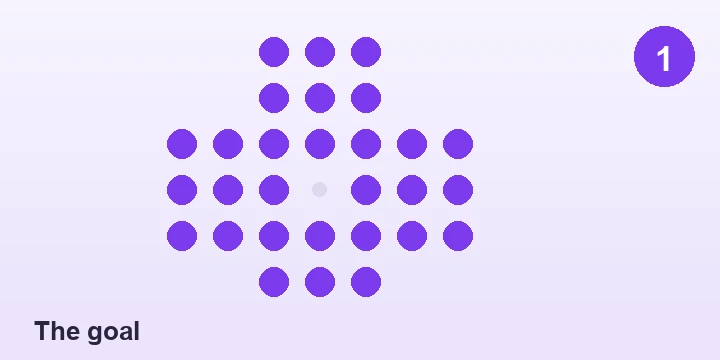
The goal
Remove pegs by jumping until only one is left. On the classic cross board the prized finish leaves that final peg sitting in the centre hole.
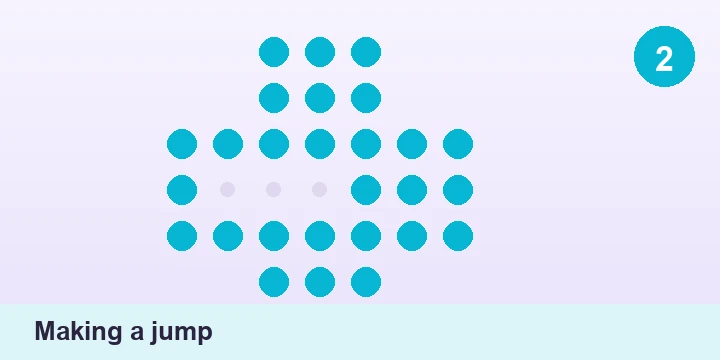
Making a jump
Click a peg, then click an empty hole exactly two spaces away in a straight line with a peg in between. Your peg leaps over that neighbour and lands in the hole.
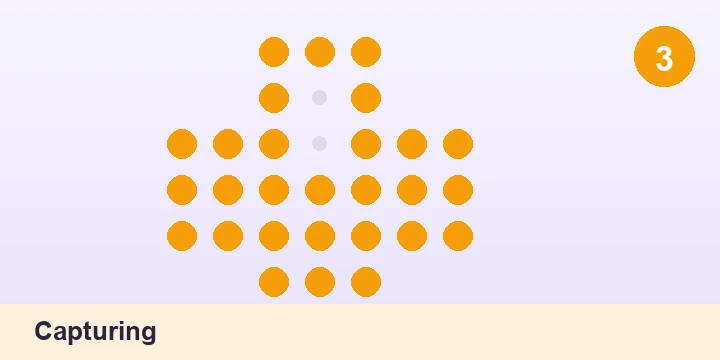
Capturing
The peg you jumped over is taken off the board. Every legal move captures exactly one peg, so the board steadily empties as you play.
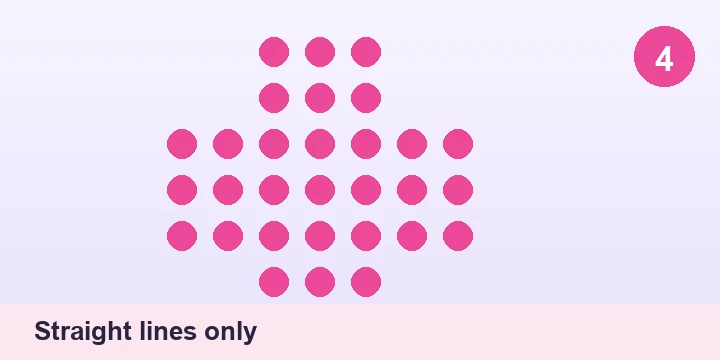
Straight lines only
On the cross board, jumps go up, down, left or right, never diagonally. A move is only legal when there is a peg to leap over and an empty hole to land in.
Winning
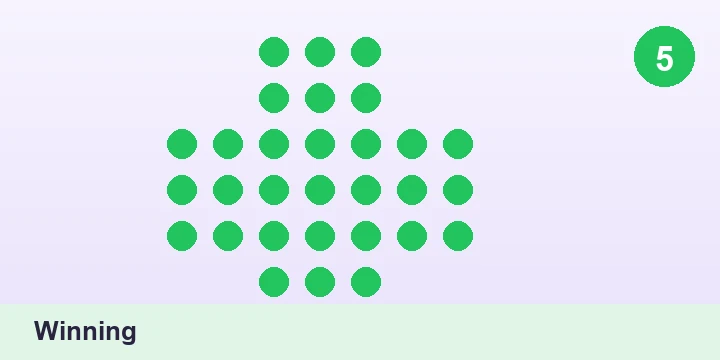
Reduce the board to a single remaining peg to win. Leaving several scattered pegs with no jumps between them means the puzzle is stuck and needs a reset.
Where Peg Solitaire came from
Peg Solitaire is one of the oldest solo puzzles still widely played. Its first clear documentation dates to around 1697 at the French court, in an engraving by Claude Auguste Berey depicting a noblewoman seated with the board, which shows the game was already fashionable by the late seventeenth century.
Two traditional shapes have dominated ever since. The English board is a cross of thirty-three holes, while the French board has thirty-seven holes with four extra corners. Each has its own solvable challenges, and the choice of which hole to leave empty at the start shapes the whole puzzle.
The game spread across Europe as a parlour pastime and never fell out of fashion, made in wood, glass and later plastic with pegs or marbles. It has also become a favourite of mathematicians, who use it to explore parity and clever counting arguments about which positions can and cannot be solved.
Tips to solve Peg Solitaire faster
💡 Best move: Best move: plan several jumps ahead rather than grabbing the easiest capture, because a peg left stranded in a corner can never be rescued once its neighbours are gone.
- On the cross board, aim from the very start to finish in the centre, since working toward that single target keeps your captures pulling inward instead of scattering.
- Clear the arms of the cross toward the middle, so pegs feed back into the busy centre rather than being abandoned at the tips.
- Avoid leaving lone pegs with empty holes all around them, because a peg needs both a neighbour to jump and a hole to land in, and an isolated one has neither.
- Look for chains where one peg can make several jumps in a row, since a multi-jump sweep clears a cluster efficiently without leaving gaps behind.
- If the board is splitting into separate pockets of pegs, redirect your moves to keep them connected, because pockets that cannot reach one another can never be finished.
Sharper tactics for Peg Solitaire
- Think in reverse. A cleared board is the same puzzle run backwards, so imagining the final centre peg and un-jumping outward can reveal an order of captures that a forwards search misses.
- Keep the pegs as one connected group. The moment the board fractures into islands that cannot jump into one another, at least one island is doomed, so guard against that split above all else.
- Sequence your captures so late jumps still have somewhere to land. Emptying a whole region too early removes the landing holes your remaining pegs will need, freezing them in place.
- Learn a few standard clearing patterns for the arms of the cross. The traditional board rewards memorised sweeps that fold each arm back toward the centre without leaving a straggler.
- On the triangle board, respect its extra diagonal jumps and its parity, because which starting hole you leave empty strongly affects where you can legally finish, so choose the opening gap with the ending in mind.
Mistakes that trip people up
- Grabbing the easiest jump every time - plan several captures ahead, because a peg left stranded in a corner can never be rescued.
- Emptying one region too early - late jumps still need somewhere to land, so do not remove the holes your remaining pegs will use.
- Letting the board split into islands - pegs that cannot jump into one another are doomed, so keep the whole group connected.
- Ignoring the finish on the cross board - aim for the centre from the start so your captures pull inward instead of scattering.
Ways to play Peg Solitaire
English cross
The classic 33-hole cross with horizontal and vertical jumps, whose famous challenge is to start with only the centre empty and finish with one peg in the centre.
Triangle board
A fifteen-hole triangular layout that allows jumps along its sloping rows, with its own set of good starting holes and satisfying single-peg finishes.
French board
The traditional 37-hole version with four extra corner holes, offering a slightly larger field and its own distinct set of solvable openings.
Marble and travel sets
Physical versions using marbles in a wooden board or pegs in a pocket-sized frame, the same jump-and-capture game in a tactile form.
Peg Solitaire questions, answered
What is the goal of Peg Solitaire?
The aim is to remove pegs by jumping one over another into an empty hole, taking the jumped peg off the board, until just a single peg is left. On the classic English cross board the celebrated result is to leave that last peg in the centre hole.
How does a jump work?
You jump a peg in a straight line over an adjacent peg into an empty hole directly beyond it, and the peg you leapt over is removed. There has to be a peg to jump and an empty hole to land in, or the move is not allowed.
Can the classic board be solved?
Yes. The standard 33-hole English cross, started with only the centre empty, can be reduced all the way to one peg finishing in the centre. It is a genuine solve, though it takes careful, forward-looking play to avoid stranding pegs.
Why do I keep getting stuck with pegs left over?
It usually means an earlier run of easy captures left one or more pegs isolated. A peg with no neighbour to jump and no hole to land in is dead, so the puzzle demands planning several moves ahead to keep every peg reachable.
Can pegs jump diagonally?
On the English cross board, jumps are only up, down, left and right, never diagonal. The triangle board is different, allowing jumps along its sloping rows, which is part of what gives that version its own distinct feel.
What is the difference between the English and triangle boards?
The English board is a 33-hole cross with horizontal and vertical jumps. The triangle board arranges the holes in a triangle and allows jumps along its sloping rows, so it plays differently and has its own good starting holes and finishes.
How old is Peg Solitaire?
It is a very old puzzle. The earliest clear record comes from the French court around 1697, in an engraving by Claude Auguste Berey showing a noblewoman with the board. Both the English 33-hole cross and the French 37-hole board have been played for centuries since.
Still curious about Peg Solitaire? Browse the full puzzle FAQ, look up a term such as logic puzzle in the puzzle glossary, or compare Peg Solitaire with the other games in the rules for every puzzle.
Last updated .