Play Nonogram
Use the number clues to fill the right cells and reveal a hidden picture.A Nonogram - also called a Picross or Griddler - is a picture-logic puzzle. The numbers beside each row and above each column tell you the lengths of the filled runs in that line, in order, so a clue of '3 1' means a block of three filled cells, a gap, then a single filled cell. Work out where every run must go and a hidden picture emerges from the grid, pixel by pixel. Nonograms are prized because they are solved by pure deduction: a well-made puzzle has exactly one solution and never requires a guess. The craft is in cross-referencing - a run you place in a row constrains the columns it crosses, which in turn pins down more of the rows - so you tick back and forth between clues, marking cells you know are empty just as carefully as the ones you fill, until the whole image resolves.
You can play Nonogram free in your browser here - a grid whose rows and columns carry number clues describing runs of filled cells. It is rated deductive and rewarding, and every puzzle has one unique, fully logical solution. Choose from 5×5 (starter) or 10×10 (classic). Your best times and solve counts save automatically, and you can take on the daily challenge or start a multiplayer race whenever you like.
How Nonogram works
In short: Use the number clues to fill the right cells and reveal a hidden picture. The play area is a grid whose rows and columns carry number clues describing runs of filled cells, it is rated deductive and rewarding, and every puzzle has one unique, fully logical solution.
Key facts about Nonogram
| Objective | Fill the cells that the clues describe and leave the rest empty. When every row and column matches its numbers exactly, the hidden picture is complete. |
|---|---|
| Play area | A grid whose rows and columns carry number clues describing runs of filled cells |
| Difficulty | Deductive and rewarding |
| Solvability | Every puzzle has one unique, fully logical solution |
| Board options | 5×5 (starter), 10×10 (classic) |
| Category | Logic puzzle |
Learn Nonogram in five steps
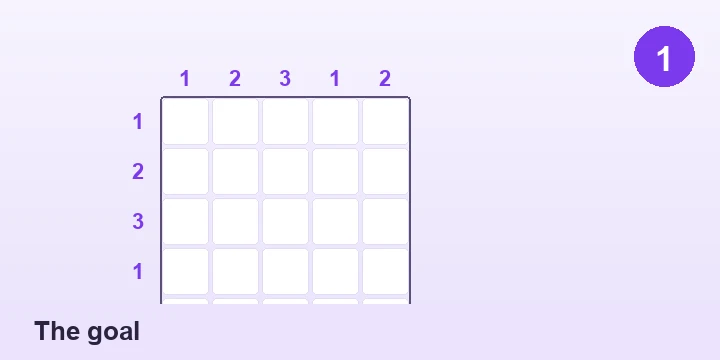
The goal
Fill the cells that the clues describe and leave the rest empty. When every row and column matches its numbers exactly, the hidden picture is complete.
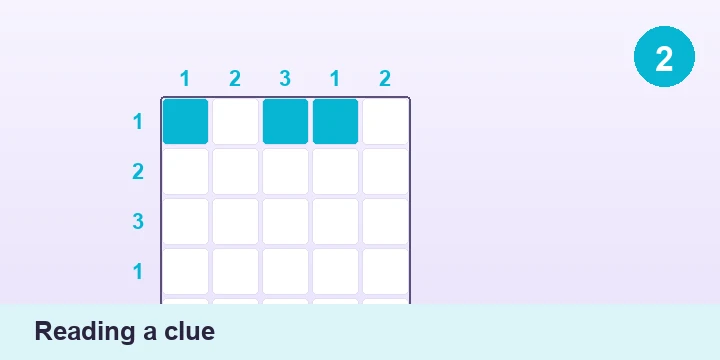
Reading a clue
Each number is the length of a solid run of filled cells in that line, listed in order. A clue of '4 2' means four filled cells, at least one empty cell, then two filled cells.
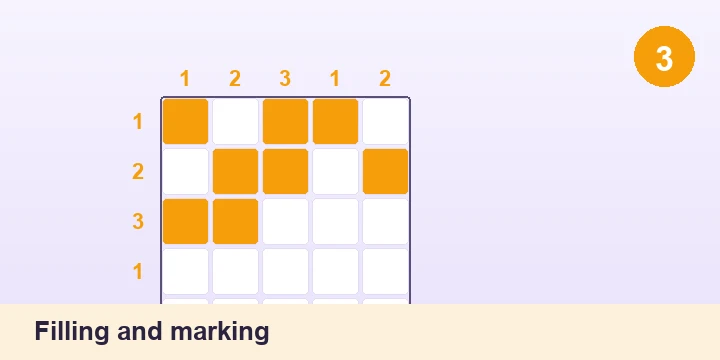
Filling and marking
Left click to fill a cell you are sure belongs to a run. Right click (or the mark tool) to cross out a cell you have proven must stay empty - those crosses are as valuable as the fills.
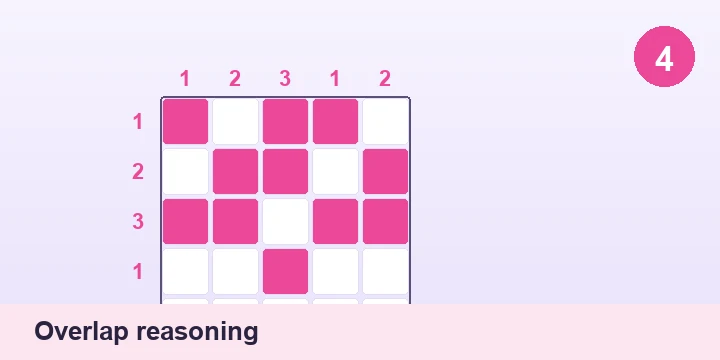
Overlap reasoning
For long runs in a line, the cells that a run must cover no matter where it slides are guaranteed filled. Start with those forced overlaps to get a foothold.
Winning
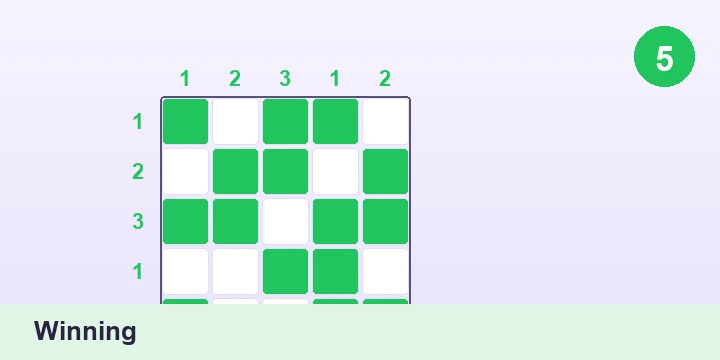
The puzzle is solved when every line satisfies its clues at once. There is only one correct picture, so no guessing is ever required to finish.
Where Nonogram came from
The Nonogram was born in Japan in the late 1980s from two independent inventors. Non Ishida, a Tokyo graphics editor, created grid pictures defined by number clues, while Tetsuya Nishio devised essentially the same puzzle around the same time; the name Nonogram is often traced to Ishida.
The puzzles reached Britain in 1990 when James Dalgety coined the name Griddler and The Sunday Telegraph began printing them. Under a shifting cloud of names - Hanjie, Picross, Griddler, Paint by Numbers - they spread through newspapers around the world.
Video games cemented their fame. Nintendo's Picross series, starting in the mid-1990s and continuing for decades, brought the picture-logic puzzle to handhelds and consoles, and today Nonograms are a staple of puzzle apps everywhere, valued for solutions that rest entirely on logic.
Tips to solve Nonogram faster
💡 Best move: Begin with the biggest clues on the smallest lines - a run that nearly fills its row or column has very little room to move, so its overlapping cells are certain fills you can place immediately.
- Mark empty cells as diligently as you fill cells; every cross you place narrows the options for the crossing line and often unlocks the next deduction.
- Play rows and columns against each other. The instant you fill a cell in a row, look at what that forces in its column, then bounce back - solutions cascade from this cross-checking.
- When a line is fully determined, cross out every remaining cell in it so it can never distract you again.
- Never guess. If you cannot prove a cell, move to a different line and come back; a correct Nonogram always yields to logic somewhere on the board.
- On the 5×5 starter board, solve it end to end by pure reasoning to build the habits that make the 10×10 picture puzzles feel manageable.
Sharper tactics for Nonogram
- Master the overlap rule precisely: for a run of length L in a line of length N, the middle 2L - N cells are always filled regardless of position - your most reliable opening move.
- Use edge anchoring - a clue whose first run must start at the wall, or whose last run must end at it, lets you place cells the interior clues cannot yet justify.
- Track 'this run cannot reach here' arguments: if placing a run in a cell would leave no room for the remaining clues in that line, that cell is provably empty.
- When two lines both touch an undecided cell, solve the more constrained one first; the extra information almost always frees the looser line.
- Keep the whole line in mind, not just one clue. The sum of all runs plus the mandatory gaps between them tells you exactly how much slack the line has to distribute.
Mistakes that trip people up
- Guessing a cell you cannot prove - a correct Nonogram never needs a guess, so move to another line and come back rather than risking the whole grid.
- Filling cells but never marking empty ones - crossing out proven-empty cells is half the puzzle and unlocks the next deductions.
- Solving rows in isolation - the moment you fill a cell, check what it forces in its column, then bounce back and forth between the two.
- Skipping the overlap rule - long runs have cells they must cover wherever they sit, so place those certain fills first for a foothold.
Ways to play Nonogram
5×5 starter
A small grid solvable at a glance, perfect for learning how runs and gaps interact before tackling a full picture.
10×10 classic
The standard size for a recognisable picture, big enough to demand real cross-referencing between rows and columns.
Coloured Nonograms
Advanced versions use multiple colours, where each clue also carries a colour and adjacent runs of different colours need no gap between them.
Mega griddlers
Large grids of twenty cells or more per side, sometimes stitched together, that produce detailed images and hours of deduction.
Nonogram questions, answered
What is a Nonogram?
A Nonogram is a picture-logic puzzle played on a grid, where numbers along each row and column describe the lengths of filled runs in that line. By working out where those runs must sit, you reveal a hidden picture. It also goes by the names Picross, Griddler and Hanjie.
How do the number clues work?
Each number is the length of one unbroken block of filled cells, and the numbers are given in the order the blocks appear. A clue of '2 1 3' means a block of two, then a gap, then a block of one, another gap, and finally a block of three, with at least one empty cell between blocks.
Do Nonograms require guessing?
No. A properly constructed Nonogram has exactly one solution reachable entirely by logic, so you never need to guess. If you feel stuck, there is always a provable move somewhere on the board - usually in a line you have not fully cross-referenced yet.
Why should I mark empty cells?
Crossing out cells you have proven to be empty is half the puzzle. Each cross removes a possibility for the line crossing it, and those eliminations frequently cascade into new fills. Solvers who ignore empty cells get stuck far sooner.
What is the overlap trick?
For any run long enough relative to its line, there are cells it must cover no matter where it ultimately sits. Filling those guaranteed overlap cells first gives you the anchor points from which the rest of the deduction grows.
What size Nonogram is good for beginners?
The 5×5 grid is ideal for learning, because you can hold the whole board in your head and clearly see how filling one cell forces others. Once the cross-referencing habit clicks, the 10×10 puzzles offer a proper picture with real depth.
Where do Nonograms come from?
They were devised in Japan in the late 1980s. The name Nonogram honours Non Ishida, a graphics editor who helped popularise them, and they spread worldwide through newspapers and later the Picross video game series.
Still curious about Nonogram? Browse the full puzzle FAQ, look up a term such as logic puzzle in the puzzle glossary, or compare Nonogram with the other games in the rules for every puzzle.
Last updated .