Play Memory Match
Flip cards two at a time and remember where each symbol hides to make every pair.Memory Match - the game generations have called Concentration or Pairs - lays a grid of cards face down, each symbol printed on exactly two of them. You turn over two cards per turn: if they match, the pair stays face up; if they do not, they flip back and it is your job to remember what was where. Clear the whole board and you win, with a better score for fewer flips. There is no luck in the long run, only attention. Early flips are genuinely random, but every card you reveal is information to bank, and skilled players turn the game into a map, recalling positions from a single earlier glimpse and chaining matches once the board is half-known. It is a gentle, satisfying workout for short-term memory that scales from a quick 4×4 to a genuinely demanding 6×6.
You can play Memory Match free in your browser here - a grid of face-down cards, each hiding a symbol that appears on exactly one other card. It is rated relaxing but sharp, and always winnable - the only limit is your memory and move count. Choose from Easy (4×4, 8 pairs), Medium (6×4, 12 pairs) or Hard (6×6, 18 pairs). Your best times and solve counts save automatically, and you can take on the daily challenge or start a multiplayer race whenever you like.
How Memory works
In short: Flip cards two at a time and remember where each symbol hides to make every pair. The play area is a grid of face-down cards, each hiding a symbol that appears on exactly one other card, it is rated relaxing but sharp, and always winnable - the only limit is your memory and move count.
Key facts about Memory
| Objective | Find every matching pair and turn the entire board face up. The game is won when no face-down cards remain. |
|---|---|
| Play area | A grid of face-down cards, each hiding a symbol that appears on exactly one other card |
| Difficulty | Relaxing but sharp |
| Solvability | Always winnable - the only limit is your memory and move count |
| Board options | Easy (4×4, 8 pairs), Medium (6×4, 12 pairs), Hard (6×6, 18 pairs) |
| Category | Memory puzzle |
Learn Memory in five steps
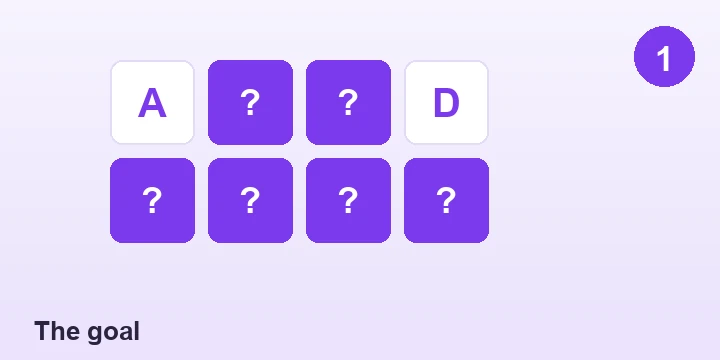
The goal
Find every matching pair and turn the entire board face up. The game is won when no face-down cards remain.
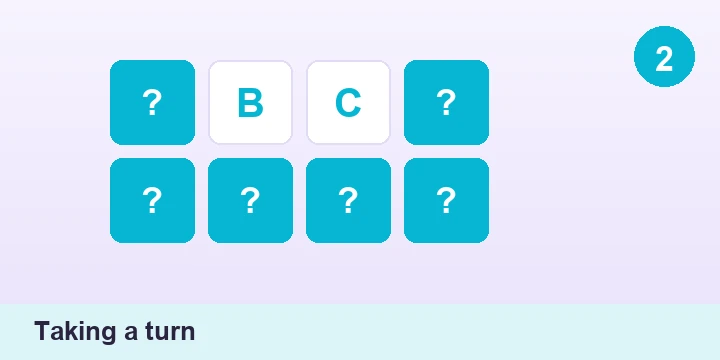
Taking a turn
Click one card to flip it, then a second. If the two symbols match, they stay revealed; if not, both flip back face down after a moment.
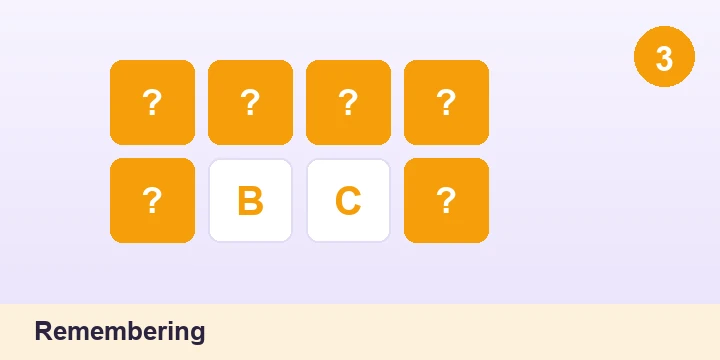
Remembering
Every card you flip - even in a failed pair - tells you where a symbol lives. Hold those positions in mind so you can claim the pair on a later turn.
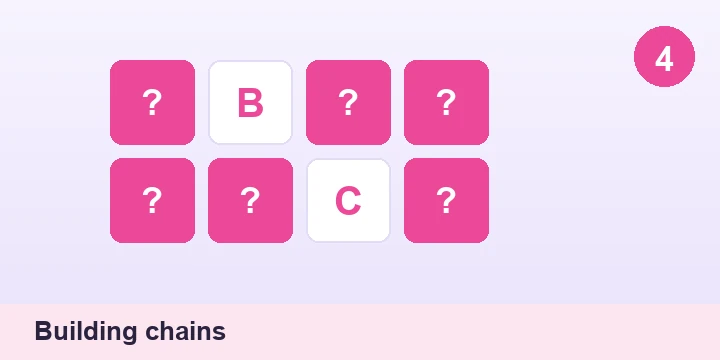
Building chains
Once you have seen a card's partner earlier, go straight for the pair. Late in the game a good memory lets you clear several pairs in a row without a single miss.
Winning
Match all the pairs to clear the board. Your move count is the number of turns you took, so the fewer mismatches you make, the stronger your result.
Where Memory came from
Memory Match descends from the parlour game Concentration, also known as Pairs or Pelmanism, played for generations with a shuffled deck of ordinary playing cards spread face down on a table. Players took turns flipping two cards, keeping any matching pair.
The name Pelmanism links it to the Pelman Institute, an early twentieth-century organisation that sold memory-training courses, reflecting a long-held belief that the game sharpens recall. Under the title Concentration it later became a long-running American television game show.
With the rise of children's games and, later, computers and phones, the pairs mechanic became a natural fit for illustrated cards and touchscreens. Today Memory Match is one of the most widely reproduced casual games in the world, a fixture of children's collections and puzzle apps alike.
Tips to solve Memory faster
💡 Best move: Turn your first flips into a survey - reveal cards in a consistent reading order early on so the positions you glimpse are easy to file away rather than scattered at random.
- When you flip a fresh card and do not know its partner, flip a second fresh card rather than a known one - you gain two new pieces of information instead of wasting a look.
- The instant you have seen both halves of a pair, take it immediately, before a later flip crowds it out of memory.
- Associate symbols with their grid position using a simple mental note - 'star, top-left' - which sticks far better than trying to photograph the whole board.
- Late in the game, clear known pairs in a deliberate sequence so you never accidentally re-flip a card you have already placed.
- Start on the 4×4 board to train the habit of banking positions, then step up to 6×4 and 6×6 as your recall improves.
Sharper tactics for Memory
- Play the information game: mathematically, revealing two unknown cards is better than pairing one unknown with a known miss, because it maximises how much of the board you learn per turn.
- Group the board into quadrants in your mind and rehearse each quadrant's revealed symbols separately - chunking beats trying to hold eighteen positions in one undivided list.
- Track not just where matches are but where a symbol definitely is not, so you can rule out cards and spend turns on genuinely unknown territory.
- On the 6×6 board, accept a few early mismatches as the price of mapping the grid, then convert that map into a long unbroken run of matches in the back half.
- Refresh fragile memories deliberately: if a position is fading, claim that pair sooner rather than gambling that it survives another few turns.
Mistakes that trip people up
- Flipping cards with no order early on - reveal them in a steady reading pattern so the positions you glimpse are easy to remember.
- Pairing a known card with an unknown one on a blind turn - flip two brand-new cards instead to learn two positions rather than one.
- Leaving a spotted pair for later - claim it the instant you know both halves, before a fresh flip crowds it out of memory.
- Trying to memorise the whole board at once - chunk it into quadrants and rehearse each separately instead of one long list.
Ways to play Memory
Easy 4×4
Sixteen cards and eight pairs - a quick, friendly round that is perfect for younger players or a fast warm-up.
Medium 6×4
Twelve pairs across twenty-four cards, the sweet spot where remembering positions starts to matter.
Hard 6×6
Thirty-six cards and eighteen pairs that push short-term memory to its limit and reward disciplined mapping.
Concentration with cards
The traditional version using a standard deck, matching by rank or by rank and colour for a tougher recall test.
Memory questions, answered
Is Memory Match a game of luck or skill?
The opening turns are largely luck because the board is unknown, but over a full game skill dominates. Every card you reveal is information, and a player who reliably remembers positions will clear the board in far fewer moves than one who flips at random.
How many pairs are on each board?
It depends on the size. The easy 4×4 board has eight pairs, the medium 6×4 board has twelve, and the hard 6×6 board has eighteen pairs to find. More pairs means more positions to hold in memory at once.
What is the best first move?
Since you know nothing yet, the best opening is simply to reveal cards you have not seen, ideally in a tidy order so their positions are easy to remember. Flipping two brand-new cards each early turn teaches you the most about the board.
Should I flip a card I have already seen?
Only when you are claiming a pair you can complete. If you flip a known card next to an unknown one and they do not match, you have spent a turn learning just one new position instead of two - a small but real waste over a long game.
Does Memory Match actually improve memory?
It is a genuine, if light, exercise for short-term and spatial memory, since it rewards recalling where symbols appeared. It will not transform your memory on its own, but it is a pleasant way to keep visual recall active and is popular with players of every age.
Can you always win Memory Match?
Yes. Every board is fully solvable - there is always a partner for every card - so the only question is how many moves it takes you. The challenge is efficiency, measured by how few mismatches you make, not whether a win is possible.
Why is it also called Concentration?
Concentration is the traditional name for the same game played with an ordinary deck of cards, matching ranks or colours. The name captures the point exactly: success comes down to paying attention and holding what you have seen in mind.
Still curious about Memory Match? Browse the full puzzle FAQ, look up a term such as memory puzzle in the puzzle glossary, or compare Memory with the other games in the rules for every puzzle.
Last updated .