Klotski
Slide the blocks aside to free the big square through the exit.Klotski is a sliding-block puzzle played in a snug rectangular tray. Blocks of different sizes, one large square, a few tall or wide rectangles and some small squares, are packed in with only a little empty space between them. There is nothing to add or remove; you simply slide the pieces around, and the goal is to work the one big block down to an opening at the bottom edge. What makes Klotski tricky is how tightly everything fits. With only two empty cells, most pieces can barely move, so freeing the big block means shuffling the smaller ones through the gaps in a long, careful dance. The famous starting layout takes over eighty moves even played perfectly. Progress often looks like going sideways or backwards, and the skill is seeing which quiet rearrangement opens the next real step forward.
You can play Klotski free in your browser here - a framed tray of blocks with one large piece to free. It is rated a sliding-block classic, and each layout is solvable in a known minimum number of moves. Choose from Huarong Pass, Warm-up or Expert. Your best times and solve counts save automatically, and you can take on the daily challenge whenever you like.
How Klotski works
In short: Slide the blocks aside to free the big square through the exit. The play area is a framed tray of blocks with one large piece to free, it is rated a sliding-block classic, and each layout is solvable in a known minimum number of moves.
Key facts about Klotski
| Objective | Slide the single large block to the exit at the bottom of the tray. The puzzle is solved the moment that big piece reaches the opening, whatever the smaller blocks are doing. |
|---|---|
| Play area | A framed tray of blocks with one large piece to free |
| Difficulty | A sliding-block classic |
| Solvability | Each layout is solvable in a known minimum number of moves |
| Board options | Huarong Pass, Warm-up, Expert |
| Category | Sliding puzzle |
Learn Klotski in five steps
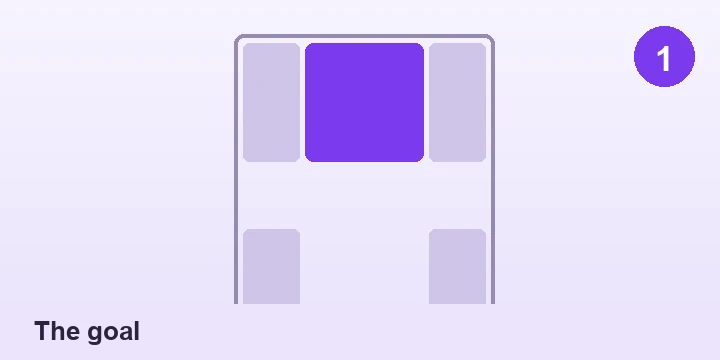
The goal
Slide the single large block to the exit at the bottom of the tray. The puzzle is solved the moment that big piece reaches the opening, whatever the smaller blocks are doing.
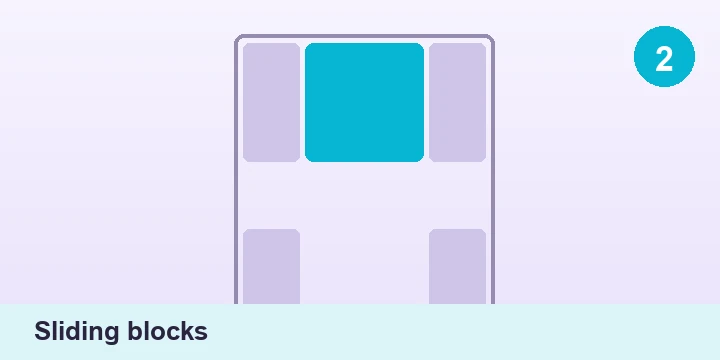
Sliding blocks
Drag or click a block to slide it into the empty space beside it. Pieces move only up, down, left or right, and only as far as the free cells allow, never lifting out or rotating.
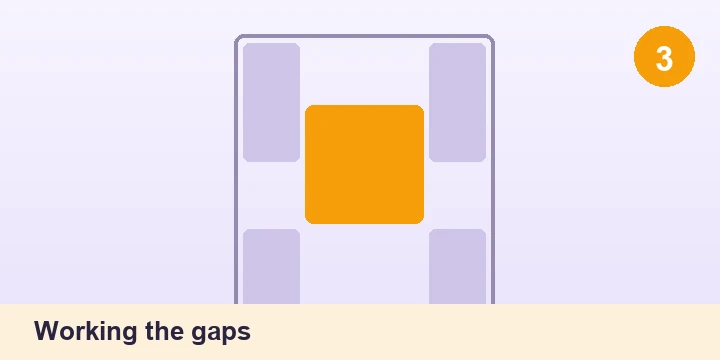
Working the gaps
The tray holds just a couple of empty cells, so most of your moves shuffle the small blocks to create room. Think of the empty space as the thing you are really steering.
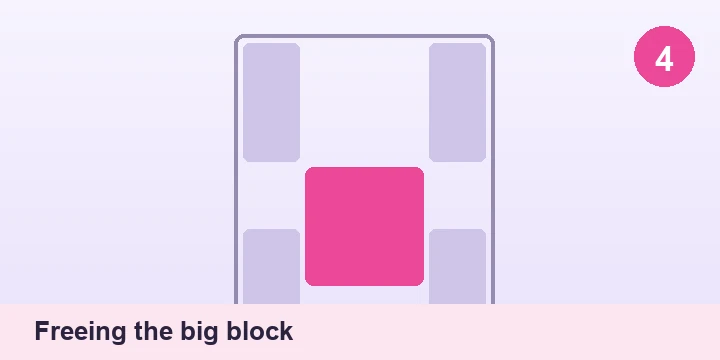
Freeing the big block
The large piece needs a clear column beneath it to slide down. Much of the puzzle is arranging the other blocks so that path opens at the right moment.
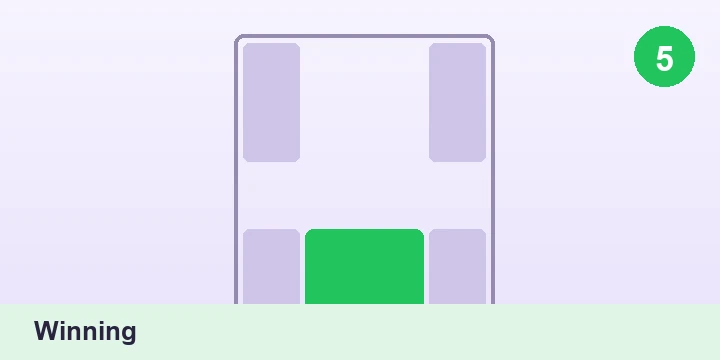
Winning
Guide the big block through the exit to win. The move counter tracks your efficiency, so try to approach the known minimum on repeat attempts.
Where Klotski came from
Klotski belongs to a family of sliding-block puzzles with a long and tangled history. Its best-known layout is the Chinese puzzle Huarong Dao, or Huarong Pass, named after a famous escape story, in which the largest block represents a general who must slip away to freedom.
Very similar puzzles appeared in the West in the early twentieth century under names like the Pennant Puzzle and Dad's Puzzle, each packing shaped blocks into a tray with one piece to liberate. The exact origins are murky, since sliding-block puzzles were reinvented in several places at once.
The name Klotski itself came from computer versions in the 1990s, which bundled many block layouts together and spread the puzzle to a new audience. Today it is a fixture of puzzle collections, admired for wringing a genuinely deep challenge out of a tiny, crowded tray.
Tips to solve Klotski faster
💡 Best move: Best move: steer the two empty cells rather than the blocks, deciding where you need a gap to appear and then feeding the small pieces toward it.
- Keep the big block's escape column in mind from the start, and avoid clogging that lane with pieces you will only have to clear away again later.
- Move the small single squares as your flexible tools, since they slip through gaps the larger rectangles cannot and are how you reshuffle the tray.
- Expect to slide pieces sideways and even backwards, because in such a tight tray making room is progress even when the big block has not budged.
- Watch the tall and wide rectangles carefully, as a misplaced long piece can wall off half the board and force a long detour to undo.
- If you feel stuck, back up several moves rather than one, since Klotski jams are usually caused by a rearrangement you made a while earlier, not the last slide.
Sharper tactics for Klotski
- Think in repeating cycles. Freeing the big block usually needs the same rotation of small pieces performed several times, so once you find a productive loop, reuse it to walk the block down step by step.
- Track the big block's row and column as your two goals. Every move either advances one of them or prepares the gaps that will, and moves that do neither are usually wasted.
- The empty cells are worth more together than apart. Two adjacent gaps let a rectangle move where two scattered gaps cannot, so keep your free space paired when you need a big shift.
- Learn the classic Huarong Pass sequence as a skeleton. Its long solution is built from a handful of recurring manoeuvres, and recognising them turns an eighty-move maze into a series of familiar chunks.
- Count moves as a discipline. Since each layout has a known shortest solution, a solve that runs far past it means you circled somewhere, so retrace to find the loop you could have skipped.
Mistakes that trip people up
- Sliding blocks at random - steer the two empty cells deliberately, feeding the small pieces toward where you need a gap to open.
- Clogging the big block's escape column - keep its downward lane in mind and avoid parking pieces there you will only have to clear again.
- Backing up just one move when stuck - Klotski jams come from an earlier rearrangement, so undo several moves to find the real cause.
- Ignoring the long rectangles - a misplaced tall or wide piece can wall off half the tray, so watch carefully where the big blocks go.
Ways to play Klotski
Huarong Pass
The classic Chinese layout with a single large block, several rectangles and small squares, whose shortest solution runs past eighty moves.
Warm-up layouts
Gentler starting arrangements with more breathing room, ideal for learning how the gaps and blocks interact before the full puzzle.
Expert packings
Denser trays that lengthen and tangle the solution, testing whether you can spot the repeating manoeuvres that free the big block.
Themed block sets
Versions that recolour or rename the pieces as families, animals or escaping characters while keeping the exact sliding rules of the original.
Klotski questions, answered
What is Klotski?
Klotski is a sliding-block puzzle in which pieces of different sizes are packed into a tray with only a little empty space. The aim is to slide the blocks around, without lifting any of them, until the single large block reaches an exit at the bottom edge.
How is Klotski different from a slide puzzle?
A number slide puzzle uses equal square tiles and one empty space, and you sort them into order. Klotski uses blocks of several shapes and sizes and asks you to free one particular big piece, so the challenge is clearing a path rather than sequencing numbers.
What is the fewest moves to solve the classic layout?
The famous Huarong Pass starting position needs at least eighty-one moves when each slide of the big block counts as a step. Most players take far more on a first attempt, which is why the move counter makes such a satisfying target to chase down.
Why can I barely move any pieces?
The tray is deliberately packed with only two empty cells, so at any moment just a few blocks have somewhere to go. Freeing more movement is itself the puzzle, since you slide the small pieces to open the gaps the bigger ones need.
Is every Klotski layout solvable?
Yes. Every layout offered here has a known, complete solution and a known minimum number of moves, so a win is always reachable. If you jam the tray, resetting returns you to a position you can definitely solve.
What do the difficulty modes change?
The classic mode is the traditional Huarong Pass arrangement. The warm-up mode uses a looser starting layout that solves in fewer moves, while the expert mode packs the tray for a longer, more tangled solution.
Where does the name Klotski come from?
The puzzle itself is old, but the name Klotski was attached to computer versions in the 1990s and it stuck. The underlying game descends from the Chinese Huarong Pass and from early twentieth-century Western block puzzles.
Still curious about Klotski? Browse the full puzzle FAQ, look up a term such as sliding puzzle in the puzzle glossary, or compare Klotski with the other games in the rules for every puzzle.
Last updated .