Play Dot Connect
Connect each pair of coloured dots and fill the whole grid, no crossings.Dot Connect is a path-drawing puzzle on a square grid dotted with pairs of coloured endpoints. For each colour there are exactly two dots, and you draw a line, or pipe, joining them by moving through the squares up, down, left and right. The twist is that once you have linked every pair, your paths must also fill the entire grid, leaving no empty cell behind. Those two demands, connect every pair and cover every square, are what make it a real logic puzzle rather than a doodle. Pipes are not allowed to cross or overlap, so the shortest route between two dots is rarely the right one; you often have to take the long way around to fill an awkward corner. Good solvers read the whole board, spot which paths are forced along the edges, and grow their solution outward from those fixed points.
You can play Dot Connect free in your browser here - a grid dotted with coloured pairs to link up. It is rated connect-the-dots logic, and every board can be filled completely with no crossings. Choose from 5x5, 7x7 or 9x9. Your best times and solve counts save automatically, and you can take on the daily challenge whenever you like.
How Connect works
In short: Connect each pair of coloured dots and fill the whole grid, no crossings. The play area is a grid dotted with coloured pairs to link up, it is rated connect-the-dots logic, and every board can be filled completely with no crossings.
Key facts about Connect
| Objective | Join every pair of matching coloured dots with a path, and fill every square on the grid. The board is solved only when all pairs are linked and no cell is left empty. |
|---|---|
| Play area | A grid dotted with coloured pairs to link up |
| Difficulty | Connect-the-dots logic |
| Solvability | Every board can be filled completely with no crossings |
| Board options | 5x5, 7x7, 9x9 |
| Category | Logic puzzle |
Learn Connect in five steps
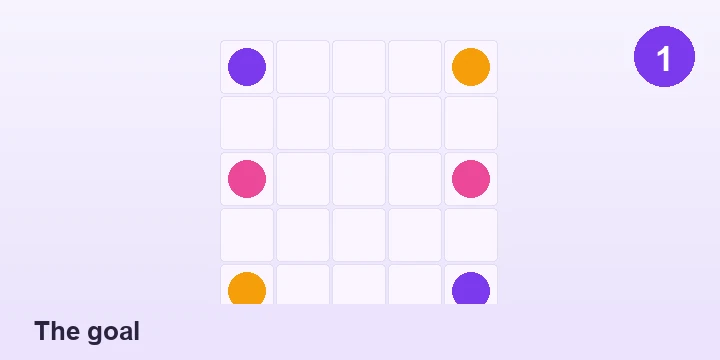
The goal
Join every pair of matching coloured dots with a path, and fill every square on the grid. The board is solved only when all pairs are linked and no cell is left empty.
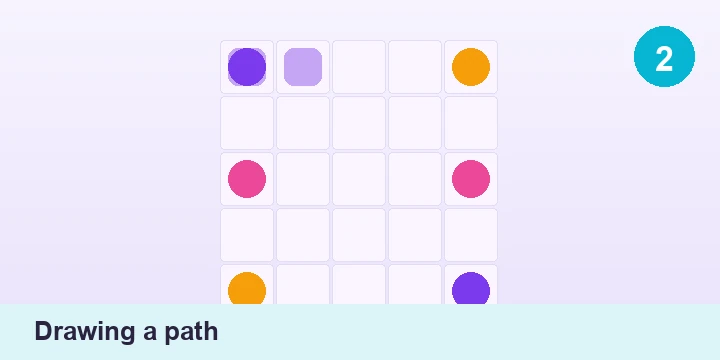
Drawing a path
Press on a coloured dot and drag through the squares to its partner. Paths run horizontally and vertically between neighbouring cells, never on the diagonal.
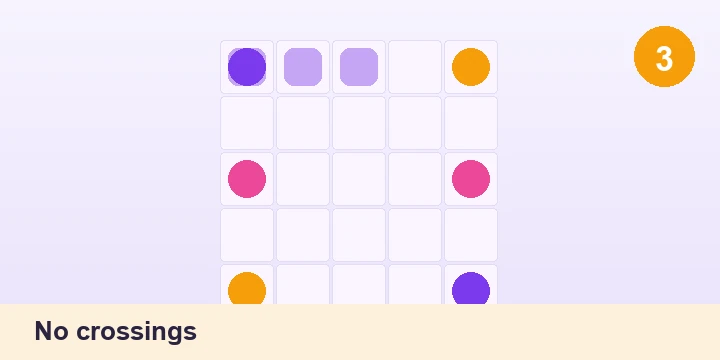
No crossings
Two paths can never share a cell or cross over each other. If your new line runs into another colour's path, one of them has to take a different route.
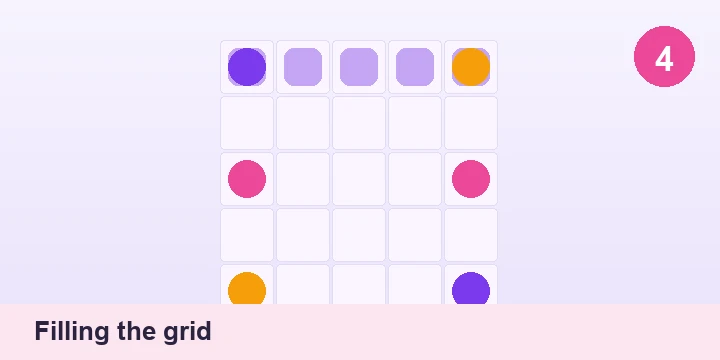
Filling the grid
A correct solution covers the whole board, so a short direct link is often wrong. You usually have to bend paths the long way round to leave no empty squares.
Winning
Connect all the pairs and cover every cell to complete the board. Redrawing a path automatically clears whatever it overwrites, so you can adjust freely.
Where Connect came from
The pipe-connecting puzzle has a longer past than its modern app look suggests. An early version of the connect-the-pairs idea appears in a puzzle by the American designer Sam Loyd published in 1897, and the concept was refined over the following century.
In Japan the puzzle took shape as Numberlink, a pencil-and-paper logic puzzle in which numbered pairs are joined by non-crossing paths that fill the grid. Numberlink established the exact rules, connect every pair, cross nothing and leave no cell empty, that the colourful versions still follow.
The format reached a huge audience in 2012 with Flow Free by Big Duck Games, which swapped the numbers for bright coloured dots and drag-to-draw controls. It became one of the most downloaded puzzle apps of the decade, and the coloured-dot style is now the way most players meet the puzzle.
Tips to solve Connect faster
💡 Best move: Best move: start with the paths forced along the edges and into the corners, because a corner cell can only be reached in one or two ways and pins down the colour that must fill it.
- Remember you must fill every square, so treat the shortest route between two dots with suspicion and be ready to loop it around to mop up empty cells.
- Work outward from the corners and walls toward the centre, where paths have the most freedom and the fewest forced moves.
- Watch for dots trapped in tight spaces, since a colour boxed into a narrow channel usually has only one legal path, so lock those in early.
- Avoid sealing off a region you still have to fill, because if a path walls off an empty pocket its colour cannot reach, you will only have to redraw.
- When two colours compete for the same corridor, work out which one has no alternative route and give it priority, letting the more flexible colour bend around it.
Sharper tactics for Connect
- Use the fill rule as a solver, not just a goal. Because no cell can be left empty, any square with only one possible colour reaching it is effectively decided, and chasing those forced cells cracks most boards.
- Read the corners first every time. A corner has just two neighbours, so whichever path passes through it is heavily constrained, and corners are the most reliable place to find a guaranteed move.
- Avoid creating isolated empty pockets. If a partial path pens off a group of cells that its own colour can never re-enter, that path is wrong, no matter how neatly it connects its dots.
- Balance the board's space. Count the empty cells each colour must cover, since a colour with two far-apart dots often has to take a long, winding route precisely because those cells belong to no one else.
- Grow from the constrained toward the free. Lock down the forced edge and corner paths first, then solve the loose central region last, where several arrangements may connect but only one also fills every square.
Mistakes that trip people up
- Linking dots by the shortest route - you must fill every cell, so be ready to bend a path the long way to leave no square empty.
- Starting in the open middle - begin at the corners and edges, where paths are forced and give you a reliable foothold.
- Sealing off a pocket your colour cannot reach - never wall in empty cells a path can no longer enter, or you will have to redraw.
- Letting paths cross - every cell belongs to one line only, so reroute one colour rather than overlapping two.
Ways to play Connect
Small 5 by 5
A compact grid with a handful of colour pairs, quick to solve and perfect for learning how the fill rule shapes each path.
Standard 7 by 7
The middle-sized board where corners and edges do most of the forcing and the central region needs real thought to fill.
Large 9 by 9
A roomy grid with many pairs, where long winding paths and careful space-counting are needed to leave no cell empty.
Numberlink style
The original pencil-puzzle form using numbered pairs instead of colours, played with the same connect, cross-nothing and fill rules.
Connect questions, answered
What is Dot Connect?
Dot Connect is a path puzzle on a grid scattered with pairs of coloured dots. You link each pair with a line that runs between neighbouring squares, and to win you must connect every pair while also covering every cell on the board, with no path crossing another.
Do the paths have to fill the whole grid?
Yes, and that is the heart of the puzzle. It is not enough to connect the dots by the shortest route; a correct solution leaves no empty square, so you often have to route paths the long way round to cover every last cell.
Can paths cross each other?
No. Every cell belongs to at most one path, so lines can never overlap or cross. If your route would run into another colour, one of the two paths has to be redrawn to take a different way around.
Is every board solvable?
Yes. Every board offered here has a solution that connects all the pairs and fills the whole grid, so it can always be completed. If you get stuck, the fix is a different arrangement of paths, not a flaw in the board.
Where should I start?
Begin at the corners and edges. A corner cell can only be entered from one or two directions, so the path through it is usually forced, and those fixed points give you a foothold to grow the rest of the solution outward.
Does the shortest path usually work?
Often not. Because you must fill every cell, the direct route between two dots frequently leaves gaps that no other colour can reach, so the correct path is commonly a longer one that bends around to cover empty squares.
Where did this puzzle come from?
It is based on the Japanese pencil puzzle Numberlink, whose core idea traces back to a Sam Loyd puzzle from 1897. The colourful touchscreen version most people know today was popularised by Flow Free, released by Big Duck Games in 2012.
Still curious about Dot Connect? Browse the full puzzle FAQ, look up a term such as logic puzzle in the puzzle glossary, or compare Connect with the other games in the rules for every puzzle.
Last updated .