Play Flood It Puzzle
Flood the whole board with one colour, spreading from the corner in as few moves as you can.Flood It is a colour-spreading puzzle with a simple loop and a surprising amount of depth. You control the top-left cell, and each time you pick a colour your whole controlled region changes to it, absorbing any neighbouring cells of that new colour into your territory. Keep choosing colours and your flood grows until, ideally, the entire board is a single shade - all within a limited number of moves. The catch is that you cannot see the future flood easily. Every choice both recolours what you already own and grabs whatever touches it, so the best move is rarely the colour that grabs the most cells right now. Winning within the move budget means thinking about which colour opens up the widest frontier for your next few moves, treating the board as a shrinking map of regions to swallow in the most efficient order.
You can play Flood It free in your browser here - a grid of coloured cells; your controlled zone grows from the top-left corner. It is rated quick and clever, and every board can be flooded within the move limit with good play. Choose from Small (12×12) or Large (18×18). Your best times and solve counts save automatically, and you can take on the daily challenge or start a multiplayer race whenever you like.
How Flood It works
In short: Flood the whole board with one colour, spreading from the corner in as few moves as you can. The play area is a grid of coloured cells; your controlled zone grows from the top-left corner, it is rated quick and clever, and every board can be flooded within the move limit with good play.
Key facts about Flood It
| Objective | Turn every cell on the board into a single colour before you run out of moves. The flood always starts from the top-left corner and grows outward. |
|---|---|
| Play area | A grid of coloured cells; your controlled zone grows from the top-left corner |
| Difficulty | Quick and clever |
| Solvability | Every board can be flooded within the move limit with good play |
| Board options | Small (12×12), Large (18×18) |
| Category | Color puzzle |
Learn Flood It in five steps
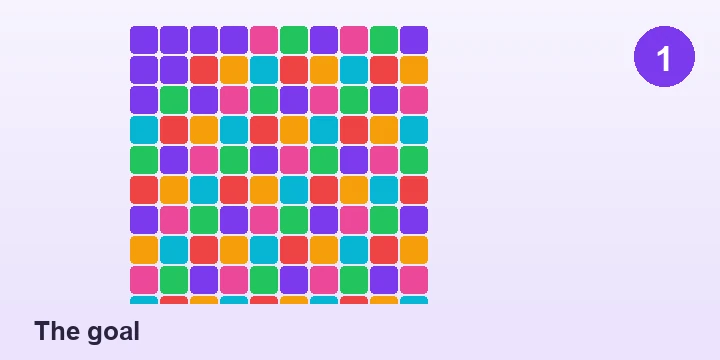
The goal
Turn every cell on the board into a single colour before you run out of moves. The flood always starts from the top-left corner and grows outward.
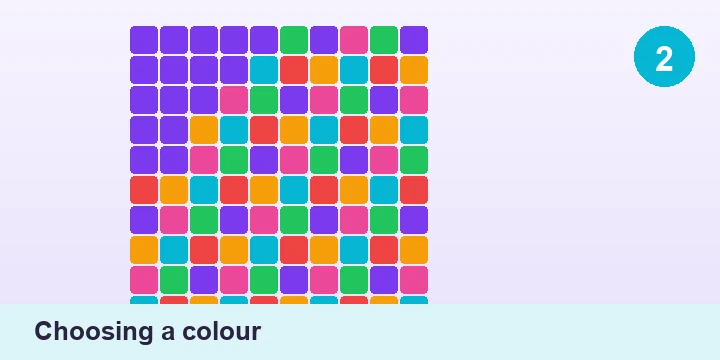
Choosing a colour
Pick a colour from the palette. Your entire controlled region instantly becomes that colour and absorbs any adjacent cells that already share it.
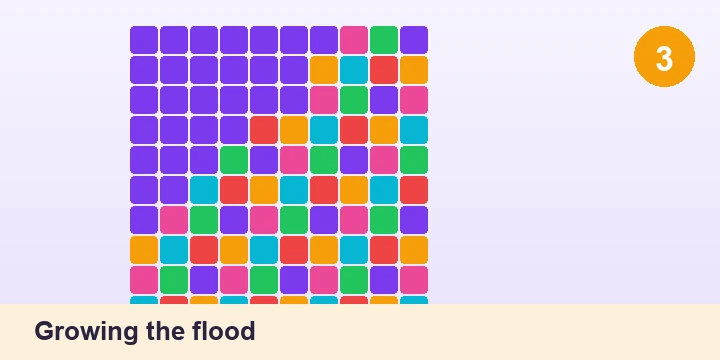
Growing the flood
Cells join your territory when they touch it and match your latest colour choice. Your region only ever grows, never shrinks, so every move expands your reach.
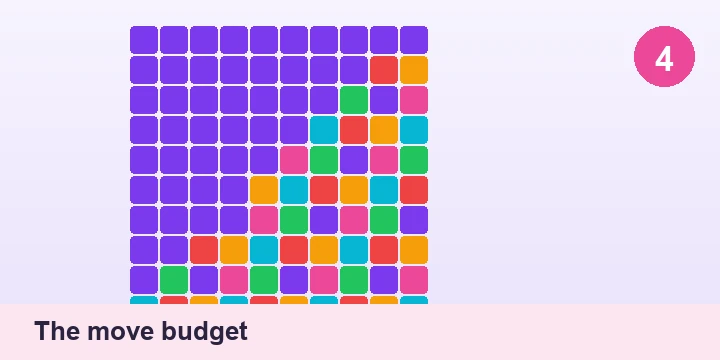
The move budget
Each board gives you a limited number of colour changes. Clearing the board within that budget is the win; running out first ends the round.
Winning
The puzzle is solved the instant the whole grid is one colour. Solving with moves to spare is the mark of an efficient flood.
Where Flood It came from
Flood It emerged as a casual mobile and web puzzle around 2009, with an early and widely played version by the studio LabPixies. Its one-thumb, one-choice-per-turn design was a natural fit for the first wave of smartphones and it spread quickly across app stores.
The game's mechanic - a controlled region that recolours and absorbs like-coloured neighbours - had appeared in earlier flood-fill and colour games, but the corner-start, move-limited format gave it a tight, replayable structure that players returned to again and again.
Flood It also caught the eye of computer scientists, who proved that finding the shortest possible sequence of moves is computationally hard in general. That academic interest, paired with its friendly appearance, made it a favourite example of a simple game hiding a genuinely difficult optimisation problem.
Tips to solve Flood It faster
💡 Best move: Do not simply grab the colour that captures the most cells this turn - look one or two moves ahead for the colour that widens your frontier and sets up an even bigger capture next.
- Push toward the far corners early. Reaching across the board fast gives your flood a broad edge to grow from, whereas fattening one side leaves the opposite corner stranded.
- Watch for large connected blocks of a single colour near your frontier and time your moves so you swallow them whole rather than in pieces.
- Avoid picking your own current colour or a colour that touches almost nothing - a wasted move against a tight budget is often the difference between a win and a loss.
- Think of the board as regions, not cells. Planning the order in which you absorb the big colour regions matters far more than the exact cell count of any single move.
- On the large 18×18 board, keep your flood spreading on a wide front; the move budget is generous only if you never let a distant region grow in isolation.
Sharper tactics for Flood It
- Favour the colour that maximises the size of your border with the rest of the board, not the colour that adds the most cells - a wide frontier compounds over the next several moves.
- Count colours near the end. When only two or three shades remain, plan the exact finishing sequence rather than picking greedily, since one misordered move can cost you the last cell.
- Reaching the opposite corner quickly effectively splits the board in your favour, letting your flood attack the remaining regions from two sides instead of one.
- Treat isolated pockets of colour as priorities - a small region that will only get harder to reach as the board unifies should be captured while a path to it still exists.
- Practise reading two moves as a pair: sometimes a small first capture unlocks a huge second capture, beating the move that looked bigger on its own.
Mistakes that trip people up
- Always grabbing the colour that captures the most cells now - look one or two moves ahead for the colour that widens your frontier instead.
- Fattening one side of the board - push toward the far corners early so a distant region does not grow stranded and out of reach.
- Wasting a move on a colour that touches almost nothing - against a tight budget every move must earn its keep, so make each one count.
- Picking greedily at the very end - when two or three colours remain, plan the exact finishing order rather than grabbing the biggest block.
Ways to play Flood It
Small 12×12
A compact board with a tight move budget - quick to play and forgiving enough to learn the frontier-first idea.
Large 18×18
A big grid that rewards planning several moves ahead and pushing your flood toward the far corners early.
More or fewer colours
Changing the number of colours dramatically alters difficulty - fewer colours make big captures easier, more colours demand sharper planning.
Free-start flood
Variants that let you begin the flood from any cell rather than the corner, opening up different strategic openings.
Flood It questions, answered
How do you play Flood It?
You control the top-left corner of a coloured grid. Each turn you pick a colour, your whole controlled region changes to it, and any adjacent cells of that colour join your territory. Keep choosing colours to grow the flood until the entire board is one colour, all within a limited number of moves.
What is the best strategy for Flood It?
The key insight is to maximise your frontier rather than your immediate cell count. Instead of always grabbing the colour that captures the most cells right now, choose the colour that gives your flood the widest border to expand from over the next few moves, and push toward the far corners early.
Is every Flood It board winnable?
Yes - every board on Puzzle.now can be cleared within its move budget with good play. The move limit is set to be generous enough for a thoughtful solver but tight enough that careless, purely greedy moves will run out before the board is unified.
Should I always pick the colour that grabs the most cells?
Not necessarily. Greedy cell-grabbing is a decent rough guide but it is not optimal. Frequently a slightly smaller capture that spreads your flood toward untouched regions or widens your frontier will win in fewer total moves than the biggest immediate grab.
How many moves do I get?
Each board size comes with a fixed move budget shown as you play. The small 12×12 board gives fewer moves for a shorter puzzle, while the large 18×18 board grants more, scaled so that efficient play clears the board with a little room to spare.
Does the flood always start in the corner?
Yes, in the standard game your controlled region begins at the top-left corner. That fixed starting point is what makes reaching the opposite corner quickly such an important strategic idea, since it lets your flood grow on two fronts.
Is Flood It a maths puzzle?
Underneath, yes - finding the shortest possible flood is a known hard computational problem, which is why there is no simple rule that always plays perfectly. For a human, though, a few good habits like frontier-first thinking make most boards very winnable.
Still curious about Flood It? Browse the full puzzle FAQ, look up a term such as color puzzle in the puzzle glossary, or compare Flood It with the other games in the rules for every puzzle.
Last updated .