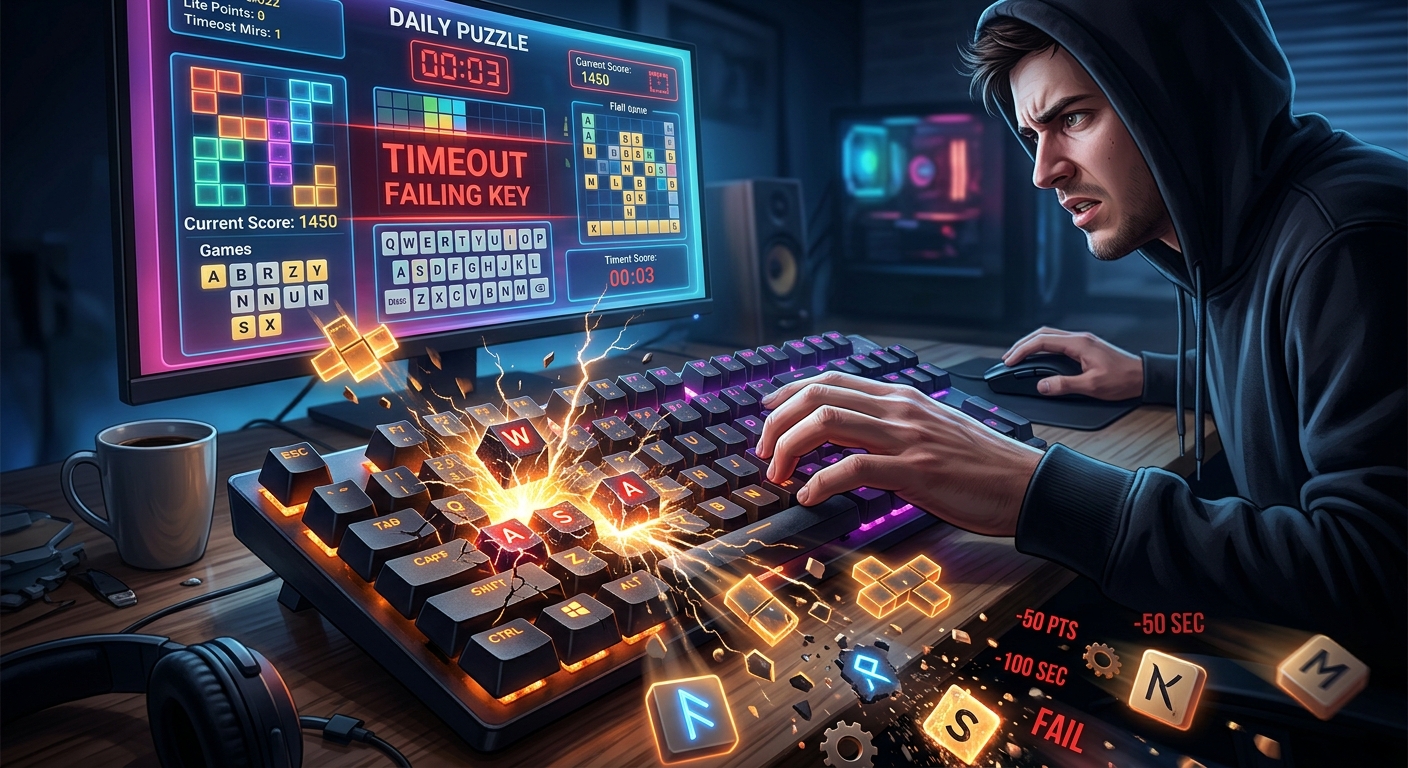
Your leaderboard time does not always reflect how well you solved the puzzle. Sometimes the gap between first and fifth place is not strategy. It is the half-second fumble on a capital letter, the reach for an unfamiliar number key, the slight hesitation before a right-hand consonant. Those moments add up fast. By the end of a timed word game, your typing habits have already decided where you land, before your puzzle instincts ever get a say.
Puzzle Intel
- Timed puzzle formats punish keyboard hesitation just as much as slow thinking.
- The number row, right-hand consonants, and shift combos are the most common weak spots for casual players.
- Targeted drills between sessions patch specific key gaps faster than general typing practice.
- Reviewing yesterday's daily challenge helps surface decision errors alongside input errors.
- Fixing weak keys shifts the bottleneck back to puzzle logic, where skill-building actually counts.
The Gap Between Knowing the Answer and Typing It
In casual puzzle play, speed rarely matters. You work through a sliding tile or logic sequence at whatever pace feels right. But the moment a leaderboard appears, or a countdown timer starts ticking, the game transforms entirely.
Word games and speed rounds measure a combined skill. They test how fast you can think and how fast you can act on that thought. If your thinking is sharp but your typing stumbles, the timer does not care. It keeps counting.
This is the hidden ceiling that most players never name. They replay a round and feel their strategy was solid. They spotted the word early. They knew the answer. And yet the final time tells a different story.
The reason is usually not puzzle logic at all. It is muscle memory, or the absence of it, at the individual key level.
The Keys That Trip Up More Players Than They Expect
Not all keys are equal in daily use. Home row letters build themselves into muscle memory through years of writing, messaging, and searching. But several keyboard zones sit just outside that comfort area, and word puzzles have a habit of demanding them at the worst possible moments.
- The number row: Many word puzzle platforms include numeric inputs, guess counters, or tiebreaker fields. Even a brief reach for a "3" or a "7" costs a fraction of a second per move, and those fractions stack.
- Right-hand consonants: Letters like P, Y, and keys near the bracket zone get far less traffic in ordinary typing. Puzzle words heavy in those consonants produce the most visible hesitation under time pressure.
- Shift key combinations: Capitalizing a letter mid-entry, especially on the right side of the keyboard, demands a two-key coordination that many players handle inconsistently when stressed.
- Adjacent center-row keys: High-speed input near the middle of the keyboard, letters like T, G, and B alongside their neighbors, leads to more misfires than players expect. Correcting a typo on the first letter of a guess costs far more time than the misfire itself.
None of these are rare keys. Most appear regularly in everyday English. The problem is that casual typing does not distribute practice evenly. You build strong habits around the letters in your own name, your most-used words, your go-to phrases. Everything else stays soft.
How Timed Formats Turn Small Delays into Real Score Gaps
A 300-millisecond hesitation feels invisible in the moment. You barely register it. Multiply it across a dozen inputs in a fast word round, though, and you have dropped several seconds from your total time.
In daily challenge formats where the same puzzle goes to every player simultaneously, those seconds translate directly into ranking. The person two spots above you may have reached the answer at the exact same moment you did. They just typed it faster, because their fingers did not pause on the second consonant cluster.
Studies in motor learning confirm that fine motor skills like typing are highly specific. Practicing one set of key combinations does not automatically carry over to different ones. Proficiency builds key-pair by key-pair, through targeted repetition. That is actually encouraging. It means you can address the exact spots where you are losing time, rather than overhauling your entire typing approach from scratch.
Between-Session Training Habits That Close Specific Gaps
The most effective training for puzzle performance is not generic speed typing. It is targeted drilling on the specific keys that already feel slow to you.
Between sessions is the right window for this. After finishing a daily challenge, your weak spots are fresh. You felt them. A certain consonant combination cost you a visible pause. A shift key misfired on a capitalized entry. That is the moment to act on it, while the memory is still sharp, before the next day's puzzle resets and the detail fades.
Running a focused session of weak keys practice after your daily puzzle means you are building muscle memory where it is actually missing, not reinforcing keys you already handle well. Isolated drills like these address the specific input bottlenecks that timed puzzle formats punish most visibly.
Other between-session habits worth building into your routine:
- Noting which specific keystrokes produced your longest pauses during the session, rather than just thinking generally about "being slower."
- Running a brief shift-key drill after any session where your capitalization timing felt inconsistent under pressure.
- Practicing short consonant-heavy words that appear frequently in word puzzles, since these tend to cluster on the weaker right-hand keys most players neglect.
Reviewing Yesterday's Challenge to Spot Decision Errors
Weak key proficiency is only one layer of your total performance. The other layer is puzzle logic itself. The best time to review that layer is the day after, when you can examine your path through the puzzle without a timer breathing down your neck.
Many players skip this entirely. They move on to today's challenge and carry the same decision patterns forward, including the ones that cost them positions yesterday. Replaying the previous session, even briefly, surfaces a different category of error. You might notice three guesses were spent on a letter cluster that a smarter opening strategy would have resolved in one. You might spot a pattern you recognized late that was visible much earlier in the board.
Combining strategic replay with targeted key drills covers both performance layers at once. The keyboard work closes the input gap. The replay closes the logic gap. Treat them as separate activities and give each its own focused time. Mixing them produces noise and you retain less from both.
The players who climb daily leaderboards consistently are almost always doing both. They are not just sharper thinkers. They are also more deliberate about what they practice between rounds.
When Your Fingers Finally Stop Setting the Ceiling
There is a threshold you cross when key proficiency catches up with puzzle thinking. It is a satisfying shift. Leaderboard times start reflecting your actual strategic ability rather than your physical input rate. You stop mentally replaying games and wondering whether you lost to a better solver or just to your own hesitation on a tricky keystroke.
At that point, puzzle logic becomes the variable that actually matters. You rise in rankings by thinking more clearly, reading the board earlier, and spotting patterns your competitors miss. That is the version of daily challenge play most competitive puzzle players are genuinely trying to reach.
Getting there requires closing the input gap first. The work is not dramatic. It is quiet, repetitive, and invisible to anyone watching your score improve. Drills between sessions do not feel like meaningful progress in the moment. They rarely do. But unlike puzzle intuition, which builds slowly through accumulated experience, key proficiency responds to targeted practice fast. A few consistent weeks on your specific weak spots can close a gap that has been quietly costing you positions for months, in a game you already know how to play.