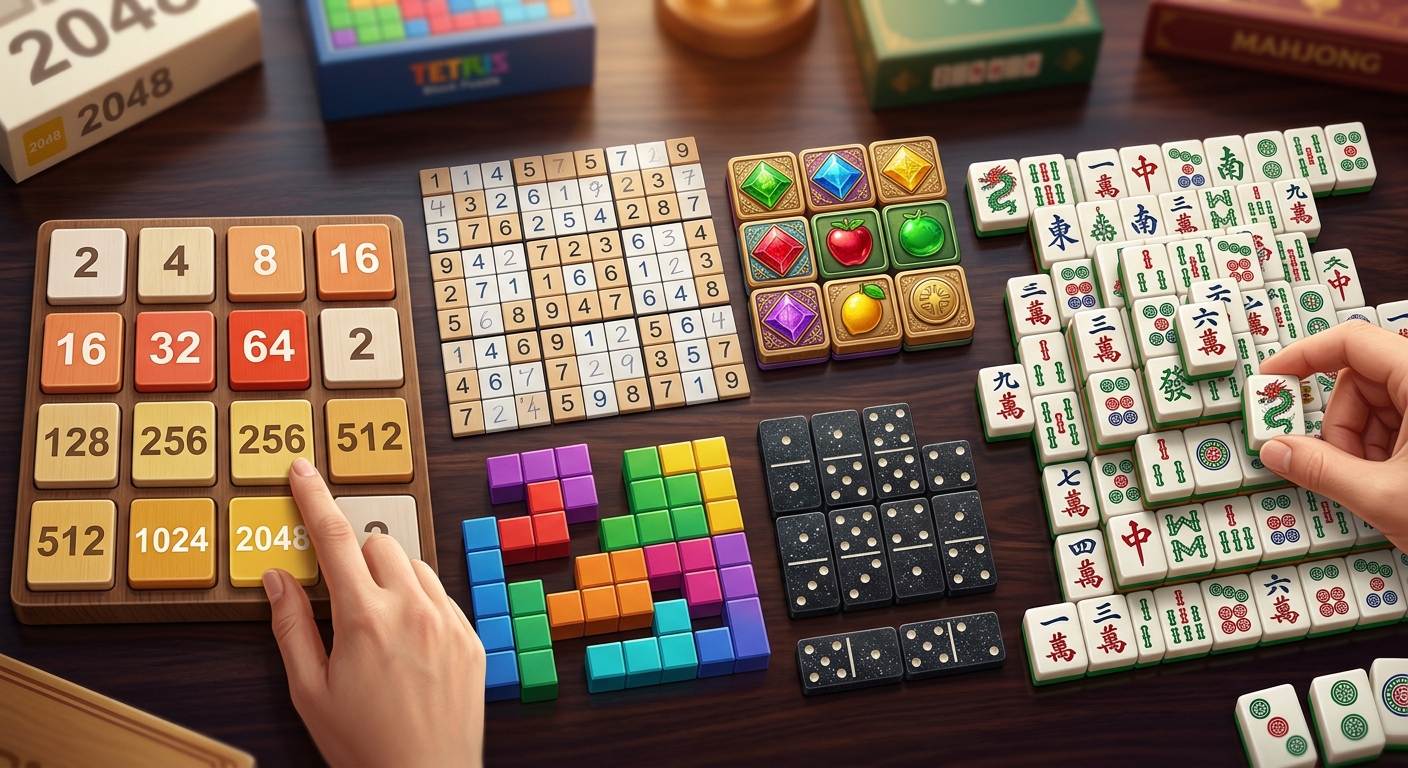
Tile games have been messing with people's heads for well over a century. From the satisfying crunch of a number doubling at exactly the right moment to the quiet logic of filling in grid squares, this category of puzzle spans a wider range of difficulty and mental demand than it gets credit for. Whether you have five minutes or two hours, there is a tile format shaped for how your brain wants to work today. This guide walks through each major type, explains what kind of thinking each one rewards, and helps you pick the right challenge for your current mood.
The Tile Puzzle Breakdown: What You Need to Know
- Number-grid games like 2048 teach core strategic thinking with minimal rules, making them ideal entry points for newer puzzle players.
- Spatial formats like sliding tiles and Nonograms train forward planning and logical deduction, with difficulty that scales steeply as grid size grows.
- Tile-matching games including Mahjong add memory and visual pattern recognition to the mix, with rulesets that vary widely across formats.
Why 2048 Is the Perfect Entry into Tile Strategy
Few games pair such a short learning curve with such a steep skill ceiling. The rules of 2048 fit in one sentence: swipe to slide all tiles, matching equal numbers to double them, and try to reach the 2048 tile. That simplicity is a trap, though. Players who treat it as a casual tap-fest hit a wall around the 512 or 1024 tile. Players who start thinking about tile positioning, corner anchoring, and value distribution can push well past 2048 toward 4096 or beyond.
The key mental shift happens when you stop thinking about what is on the board right now and start thinking two or three moves ahead. Holding your highest tile in one fixed corner is the most reliable strategy for intermediate players. From there, you build a descending chain of values along two edges, keeping your options open without scattering high-value tiles across the grid. The brain skill being trained here is sequential planning: the ability to hold a future state in mind while making a present-tense decision.
That skill transfers surprisingly well to other puzzle types. Players who get good at 2048 often find that their spatial reasoning in other grid games improves without additional practice. It is a strong starting point for anyone new to strategy-based puzzles.
Sliding Tile Puzzles and the Discipline of Long Chains
The 15-puzzle, a 4x4 grid with one empty square and 15 numbered tiles, has been frustrating players since the 1870s. The mechanic is simple: slide tiles into the empty space until they line up in order. The difficulty is anything but simple. With 15 tiles and a single gap, the number of possible board states is enormous, and finding the shortest solution path requires thinking in full chains of moves rather than one step at a time.
Novice players tend to solve one row at a time, which works for the top two rows. The bottom rows require a technique called cycling, where you rotate three or more tiles around a small region without disturbing the tiles already in place. This is hard to visualize at first. Most players need to fail several times before they internalize the pattern. That failure-and-retry loop is part of what makes the format so effective for building spatial intelligence.
Difficulty scales sharply with grid size. A 3x3 puzzle is solvable in a few minutes with patience. A 5x5 puzzle demands genuine expertise. Grid size is the main adjustment that puzzle platforms use to control challenge level, and it is a reliable one. If sliding tiles feel too easy or too hard, adjusting the grid one step in either direction usually fixes the balance for most players.
How Nonograms Train a Different Kind of Logic
Nonograms, sometimes called Picross or griddler puzzles, run entirely on deductive reasoning. Each row and column carries a clue: a sequence of numbers that tells you how many filled squares appear in that line and in what order. Your job is to use overlapping logic across rows and columns to figure out which squares must be filled and which must stay empty. The finished grid reveals a pixel-art image.
The format traces back to Japan in the late 1980s, where these puzzles appeared in puzzle magazines before spreading globally. Today they are one of the most respected formats in competitive puzzle culture, largely because they reward patience and systematic thinking over intuition or speed.
Beginners often start by trying to guess squares. That approach breaks down quickly on grids larger than 10x10. The correct method is to work only with certainty: mark a square only when logic forces it to be filled or empty, and leave ambiguous squares untouched until more information fills in around them. This trains a specific mental habit: resisting the urge to commit before you have enough evidence. Research on Nonogram solving strategies confirms that even the largest grids remain solvable through pure logic without guessing, a property that makes them uniquely satisfying for deduction-oriented players. That habit has real value beyond puzzles, but within the puzzle context it is what separates fast solvers from frustrated ones.
Tile-Matching Games and the Role of Visual Pattern Recognition
Number-grid games and logic puzzles are largely about rules and sequences. Tile-matching games shift the challenge toward visual recognition and memory. In matching formats, the goal is typically to identify and remove pairs or groups of identical tiles before time runs out or the board locks up. The skill is not calculation. It is the ability to scan quickly, recognize patterns under visual noise, and prioritize which pairs to clear first for maximum board management.
This is a genuinely different cognitive demand. Players who dominate in 2048 or Nonograms sometimes struggle with tile-matching games initially because the format rewards different instincts. There is less forward planning and more real-time visual processing. For players who find number-based puzzles stressful, tile-matching often feels more relaxing while still being mentally engaging.
How Difficulty Stacks Up Across the Major Tile Formats
| Format | Primary Skill | Beginner Difficulty | Expert Difficulty | Best for |
|---|---|---|---|---|
| 2048 | Sequential planning | Low | High | Building strategic thinking |
| Sliding Tiles | Spatial planning | Medium | Very high | Spatial intelligence training |
| Nonogram | Logical deduction | Low to medium | Very high | Methodical, patient thinkers |
| Tile Matching | Visual recognition | Low | Medium | Relaxed, visual players |
| Mahjong Solitaire | Memory and strategy | Medium | High | Depth-seekers and strategists |
Mahjong Has More Depth Than Most Players Realize
When most browser players hear "Mahjong," they picture the solitaire version: a pile of face-up tiles stacked in a layout, and the goal of clearing the board by matching free pairs. That version is genuinely enjoyable. It tests memory, visual scanning, and strategic sequencing. But it only scratches the surface of what the Mahjong format can offer.
Mahjong as a category includes fundamentally different rulesets, tile sets, and strategic demands. Some versions are competitive multiplayer games with hand-building mechanics closer to card games than to solitaire. Others use regional tile sets with unique symbols that change how matching works entirely. The solitaire format you find most often in browsers is one branch of a much wider family of games, and Mahjong variants cover formats that range from meditative solo play all the way to fast-paced competitive modes, giving players with very different preferences something to work with.
Even within Mahjong solitaire, the strategy runs deeper than most beginners expect. The common mistake is matching any available pair without thinking ahead. Experienced players evaluate each potential match based on what tiles it will unlock. Clearing a tile from the top of a stack reveals what is underneath, and that sequence matters enormously. A pair that looks safe to clear now might block three other matches if you take it at the wrong moment. Good Mahjong players think about access, not just availability.
Building Your Path Through the Tile Puzzle Formats
If you are mapping a progression through tile puzzles, here is a sensible order that builds skills cumulatively rather than jumping straight to the deep end:
- Start with 2048. The rules are minimal, sessions are short, and you will quickly notice how strategic habits form. Play until you clear the 2048 tile at least once before moving on.
- Move to Mahjong solitaire. This introduces visual complexity and memory without requiring the kind of deductive grinding that logic puzzles demand. It is a gentle step up that also builds tile-set familiarity.
- Try a small Nonogram. Begin with a 5x5 grid. Focus on solving by certainty only. Once that feels comfortable, move to 10x10, then 15x15. Resist the jump too early.
- Attempt a 4x4 sliding tile puzzle. This is where spatial difficulty becomes serious. Expect to spend real time here. The cycling technique takes multiple sessions to internalize.
- Take on larger versions of whatever clicked most. 15x15 Nonograms, 5x5 sliding grids, competitive Mahjong modes. By this point you will know which format your brain prefers.
This order is a suggestion, not a requirement. Some players find Nonograms immediately absorbing on the first attempt. Others burn out quickly on logic-heavy formats and thrive in faster-paced matching games. The progression above works well for players who want to build transferable reasoning skills, but any starting point is a good starting point as long as you are playing.
Matching Your Brain State to the Right Format Each Day
Not every puzzle session calls for the same kind of mental effort. Part of getting the most from tile games is recognizing what your brain is ready for at a given moment.
When you are focused and clear-headed, Nonograms and sliding tiles pay off the most. These formats require sustained concentration and reward systematic thinking. They are best suited to morning sessions or any time you have a real block of uninterrupted focus available.
When you are tired but still want to engage, Mahjong solitaire and tile-matching games are the better fit. The visual nature of these games allows for a lighter cognitive load. You are still solving puzzles, but the demand is more intuitive and less grinding. There is no shame in choosing the gentler format. That is still active brain engagement, and it beats staring at a screen passively.
When you want a short session with a satisfying arc, 2048 delivers reliably. A single game rarely lasts more than ten minutes for most players, and each run has a clear sense of progression. It is also easy to pick up mid-session and put down without losing your place in a complex deduction chain.
Knowing your format options means you can always find the right game for the right moment. The tile puzzle category looks uniform from the outside. Up close, it is a wide collection of very different brain challenges, each with its own language and its own rewards for players willing to learn it.
What Your Tile Game Preferences Actually Tell You About How You Think
The tile format connects puzzle types that look similar but demand completely different skills. 2048 trains sequential planning. Sliding tiles build spatial discipline. Nonograms reward careful, evidence-based logic. Tile matching exercises visual speed and pattern recognition. Mahjong layers memory and strategy together in a format with more variety than most players ever fully see.
None of these formats is objectively harder than the others. They are harder in different ways, for different players, on different days. The player who struggles with the cold logic of a 15x15 Nonogram might breeze through an expert Mahjong layout. The reverse is just as true. What matters is that each format has a version accessible to beginners and a ceiling that can challenge expert players for years.
Start with the one that sounds most interesting. Push until it gets hard. Then either push through or try another format and return when you are ready. The tile puzzle world has no gatekeeping. Every starting point leads somewhere worth going.