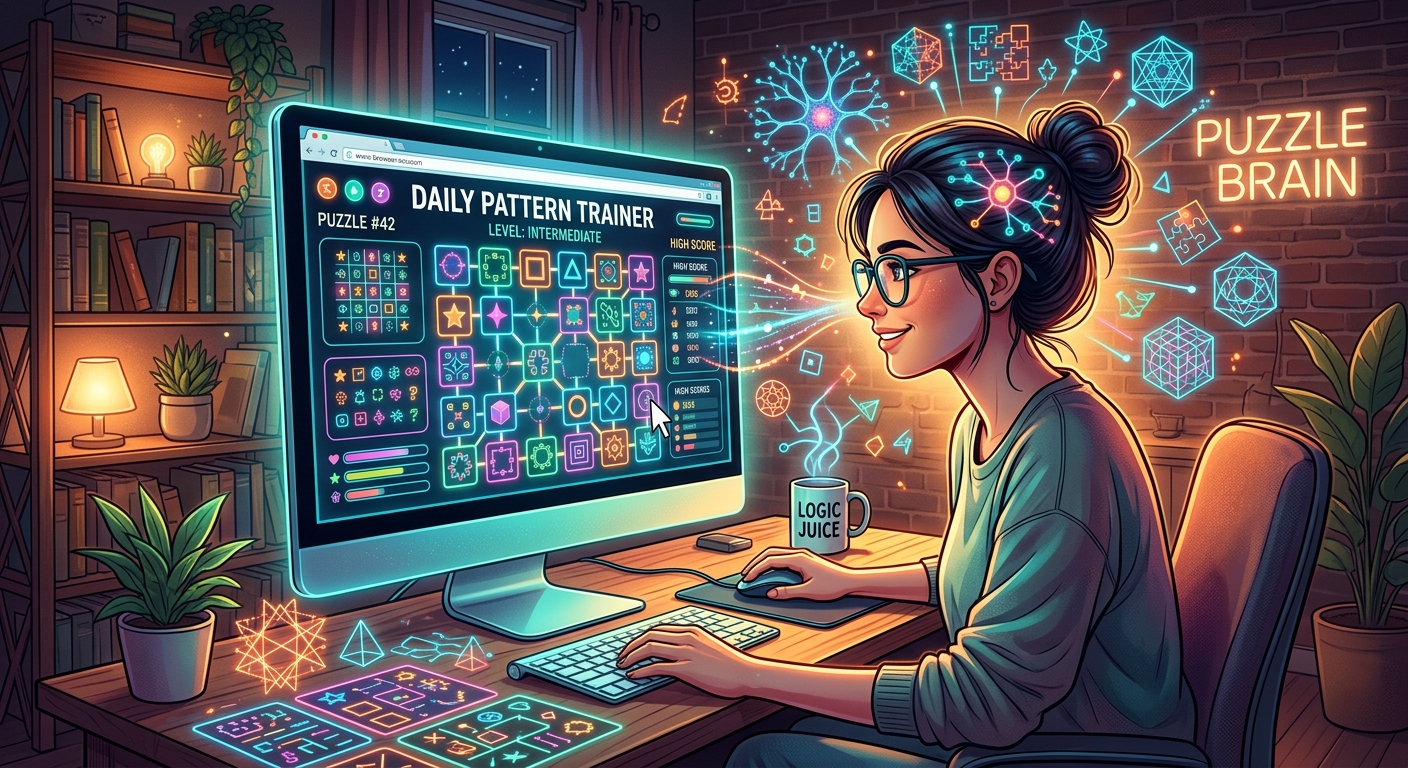
Your daily puzzle session is doing more than killing time. Every time you scan a Nonogram row, chain tiles in 2048, or flip matching cards in a memory grid, your brain is quietly sharpening one of its most versatile tools: the ability to spot patterns fast and act on them accurately. Most players never think about it that way. They just play. But the training is real, and it stacks up over time in ways that eventually show up on leaderboards.
The core skill powering every puzzle you play is pattern recognition, and your daily habit is already building it, even when you are just playing for fun.
- Nonograms, sliding tiles, memory grids, and 2048 each train a distinct dimension of pattern reading speed and accuracy.
- Taking a timed baseline test before committing to a practice routine gives you a concrete number to track real progress against.
- Competitive players who compare benchmark scores alongside daily challenge results gain a measurable feedback loop that motivates consistent improvement.
Pattern Recognition Is the Core Skill Every Puzzle Type Is Built On
Ask a seasoned Nonogram solver what they are actually doing when they fill in cells, and they will probably say something like "reading the clues." But underneath that, they are comparing number sequences against a mental model of what the grid should look like, then testing possibilities until one fits. That is pattern recognition doing its job quietly in the background.
The same process runs through 2048. Players who reach high tiles are not calculating every move as a math problem. They are reading the board as a shape. They recognize formations that signal a merge is coming, and they steer the layout toward configurations they have seen succeed before. The numbers matter less than the visual structure those numbers form.
Even a memory card grid, which looks like pure recall, is actually a pattern task. Players who improve the fastest learn to group cards by position clusters and visual similarity rather than memorizing each card as an isolated fact. The brain reaches for structure because structure is faster to retrieve than raw data points.
Pattern recognition is not a single neat ability. Psychologists often describe it as a cluster of related processes: visual-spatial processing, working memory integration, and predictive inference. Browser puzzle games train all three, often at the same time. That overlap is a big part of what makes them effective as a low-effort cognitive workout with measurable returns.
What Four Classic Puzzle Types Are Quietly Teaching You
Nonograms Build Row-by-Row Logic Chains
Nonogram solvers develop the habit of reading constraint clues and immediately mapping them against possible grid positions. Over time, the brain starts storing "this clue shape means this fill pattern" shortcuts. Players stop calculating step by step and start recognizing whole row configurations at a glance. Speed improves dramatically, and errors drop, not because players think harder but because the pattern library in their head grows larger and faster to access.
Sliding Tile Puzzles Train Spatial Sequencing
A sliding tile puzzle forces you to hold the goal image in mind while planning a sequence of moves that visually rearrange the current state. Your brain runs a continuous loop comparing "where pieces are" against "where they need to be." Players who get fast at sliding puzzles almost always report that they can visualize move sequences in advance. They are no longer moving pieces one at a time by trial. They are reading ahead through pattern matching.
Memory Grids Develop Rapid Visual Encoding
The classic memory card game puts real pressure on visual encoding speed. Novice players struggle because they try to memorize individual card locations as separate facts. Skilled players group cards into spatial patterns, like remembering that two matching tiles sit in opposite corners rather than encoding two independent coordinates. That shift from item-level to pattern-level memory is a measurable cognitive upgrade, and it transfers to real-world tasks that require fast scanning of visual information.
2048 Teaches Predictive Pattern Chains
Getting past 1024 in 2048 is a pattern problem, not a math problem. Players who stall at mid-game tiles are usually reacting to the board one move at a time. Players who break through recognize longer chains. They can see three or four moves ahead because the board state matches a pattern they have solved before. The game trains forward-model thinking, the same ability that helps with chess, coding, and fast real-world decision tasks where outcomes depend on reading a situation before it fully develops.
How Puzzle Types Stack Up as Pattern Recognition Training
| Puzzle Type | Primary Pattern Skill | Speed vs. Accuracy Emphasis | Training Ceiling |
|---|---|---|---|
| Nonogram | Constraint reading and logic chains | Accuracy first, then speed | Very high |
| Sliding Tiles | Spatial sequencing and move planning | Balanced | High |
| Memory Grid | Visual encoding and recall grouping | Speed driven | Moderate |
| 2048 | Predictive chain recognition | Accuracy first | Very high |
Measuring Your Baseline Before You Commit to a Practice Routine
There is a mistake most players make when they decide to get serious about puzzle performance. They just play more. Playing more does help, but without a baseline measurement, you have no way of knowing whether you are genuinely improving or simply getting comfortable with the same difficulty level over and over.
A baseline gives you a starting number. Then every few weeks, you remeasure. If the number climbs, the training is working. If it stalls, you know to increase difficulty or rotate puzzle types to keep the brain adapting rather than coasting.
For pattern recognition specifically, a timed test works best. You need a tool that measures both how fast you spot a pattern and how accurately you respond under time pressure. Running a pattern recognition test before committing to any practice schedule gives you exactly that: a clean, reproducible score you can return to every few weeks and compare against your current ability.
The test format matters enormously. A useful benchmark presents sequences or grids and asks you to identify which option matches or continues the pattern, all within a timer. That combination of time pressure and accuracy scoring is what separates a genuine ability measurement from a casual puzzle session where you can sit and think as long as you like.
Building a Daily Routine That Actually Moves Your Scores
Knowing your baseline is the first step. Turning it into consistent improvement takes a structured approach. The good news is that the routine does not need to be long. Research on skill acquisition consistently points to short, daily sessions outperforming long, infrequent ones for building the automatic pattern fluency that puzzle play rewards.
Here is a routine that works at any level:
- Set a fixed daily time block. Even fifteen minutes is enough. Consistency beats session length every time for building durable pattern memory.
- Start with your weakest puzzle type. Comfortable puzzles feel good but train less. Discomfort is where pattern libraries actually grow.
- Spend at least five minutes one difficulty step above your comfort level. If you usually solve medium Nonograms, push into hard. The mismatch forces active pattern searching rather than pattern recall, which is where real adaptation happens.
- End with a free-play session on a puzzle you genuinely enjoy. This reinforces the positive feedback loop and keeps the habit sticky long term.
- Retest your benchmark every two to three weeks. Compare the score to your original baseline. Note which puzzle types you have been focusing on most, and check whether that correlates with where your scores are moving.
Why Repetition Turns Slow Recognition Into Automatic Reflex
The brain does not process patterns the same way after a hundred repetitions as it does after ten. Early on, recognizing a pattern is a deliberate, effortful process. You scan, compare, test possibilities, and confirm. With enough repetition, that process compresses into something far closer to a reflex. The pattern triggers a response before conscious reasoning even kicks in.
This is why experienced 2048 players can glance at a board and almost immediately know which corner to anchor their highest tile, without running through explicit logic each time. The board configuration has matched a stored pattern template so many times that the response is automatic. It feels like intuition because it has been compressed to that level.
The same compression happens in Nonograms. New players work through clues slowly and carefully. Veterans scan a row and the constraint clues trigger immediate visual hypotheses, most of which turn out to be correct. That speed is not raw intelligence. It is accumulated pattern memory that has been rehearsed to the point of behaving like instinct.
The skills that transfer out of this kind of training are worth paying attention to:
- Faster identification of visual anomalies in documents, data, and real-world environments
- Improved ability to read situations before they fully develop, useful in fast-moving games and planning tasks
- Better working memory efficiency, meaning you can hold more context in mind without mental fatigue setting in
- Stronger spatial reasoning, which carries over into map reading, design work, and mechanical problem solving
These are not theoretical benefits sitting behind a paywall of academic papers. They show up in how quickly players climb daily challenge rankings once their baseline pattern speed improves. The puzzles get easier, not because the difficulty drops but because your processing speed increases relative to the demands of the grid.
From Benchmark Numbers to Real Leaderboard Gains
For competitive players, the feedback loop is the most motivating part of the whole system. Leaderboards show you where you rank today. A benchmark test shows you why. When your pattern recognition speed improves by a measurable margin on the benchmark, you will almost always see that reflected in how fast you complete daily challenges. The two metrics are tracking the same underlying ability from different angles, and watching them move together is genuinely satisfying.
Players who monitor both tend to improve faster. Seeing a score climb on the benchmark creates real motivation to keep the daily puzzle habit going. It also helps you identify which puzzle type is giving you the most training value right now. If your Nonogram times are dropping but your 2048 scores have flatlined, you know where to direct your next few weeks of deliberate practice.
The leaderboard is not just a vanity metric. It is real-time feedback from players across every skill level, showing you where your pattern processing stands in relation to others putting in similar work. Combined with benchmark testing, it transforms a casual habit into a trackable skill progression with clear direction.
Play the puzzles you love. Play them daily. But also measure, because knowing your numbers is what turns a good habit into a genuine competitive edge over time.