Pick a Puzzle Game and Start Playing
Hand-built puzzles, a daily challenge, and live head-to-head races. Play the Slide Puzzle right here.Puzzle.now is a free collection of brain-teasers you can play the second the page loads - the Slide Puzzle, 2048, Lights Out, Nonogram, Memory Match and more. There is nothing to install and no account to create; a daily challenge gives everyone the same board, and live multiplayer lets two players race the identical puzzle side by side.
The board is a classic Slide Puzzle: shuffle the numbered tiles, then work them back into order around the single empty square. Pick a 3×3, 4×4 or 5×5 grid, use the hint and undo buttons whenever you like, and your best times and solve counts save automatically. When you are ready for something different, jump to the full puzzle list or read the rules for every game.
Other games worth playing
How Slide Puzzle works
In short: Slide the numbered tiles into order around one empty square. The play area is a square grid of numbered tiles with a single empty space to slide into, it is rated easy to learn, hard to master, and every scramble we deal is guaranteed solvable.
Key facts about Slide Puzzle
| Objective | Arrange the tiles in ascending numerical order, left to right and top to bottom, with the empty square finishing in the bottom-right corner. |
|---|---|
| Play area | A square grid of numbered tiles with a single empty space to slide into |
| Difficulty | Easy to learn, hard to master |
| Solvability | Every scramble we deal is guaranteed solvable |
| Board options | 3×3 (8 tiles), 4×4 (15 tiles), 5×5 (24 tiles) |
| Category | Sliding puzzle |
Learn Slide Puzzle in five steps
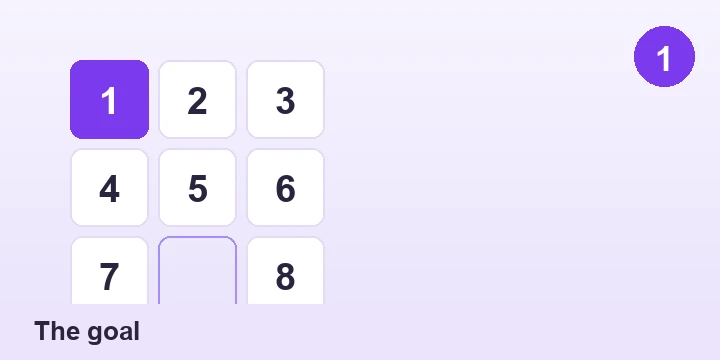
The goal
Arrange the tiles in ascending numerical order, left to right and top to bottom, with the empty square finishing in the bottom-right corner.
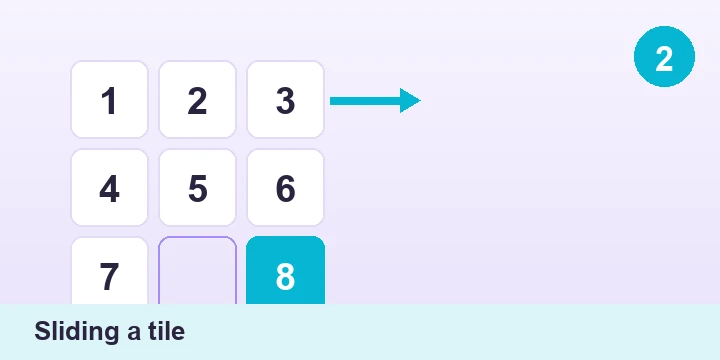
Sliding a tile
Click or tap any tile in the same row or column as the empty square and it slides into the gap. You can move a whole line of tiles toward the gap in one click.
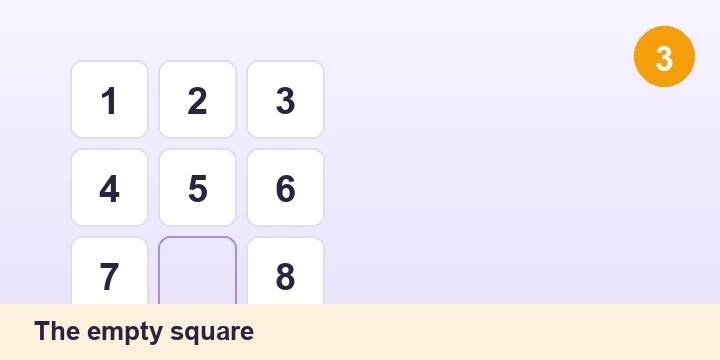
The empty square
Only the space beside the gap can move. The empty square is your tool - think of yourself as steering the hole around the board rather than shoving tiles at random.
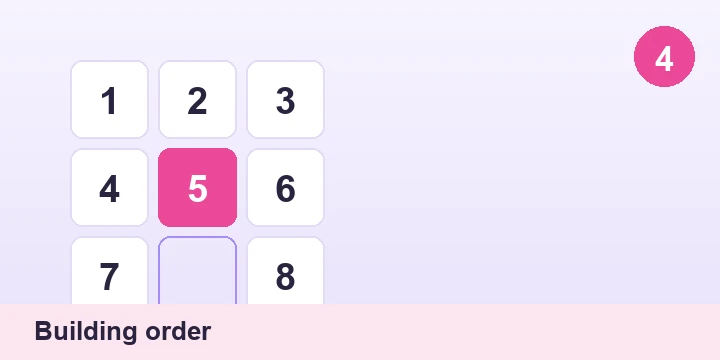
Building order
Lock in the top row and the left column first, then treat the smaller remaining block as its own puzzle. Solved tiles should stay put while you work the rest.
Winning
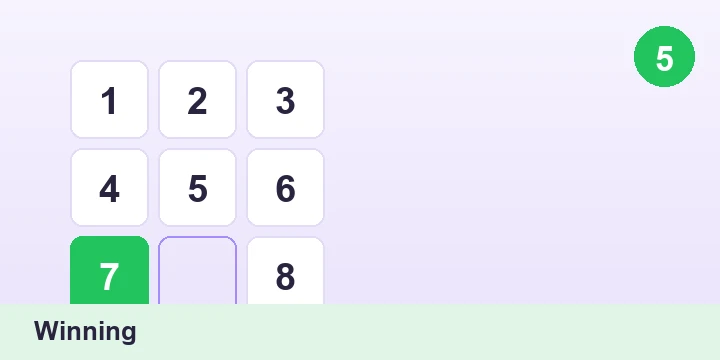
The puzzle is complete the instant all tiles read in order. Your move count and timer stop, and a lower move count beats a fast but sloppy solve.
Where Slide Puzzle came from
The sliding tile puzzle was invented in the United States around 1874 by Noyes Palmer Chapman, a postmaster in Canastota, New York, who arranged numbered blocks in a tray. Within a few years it had spread from New England into a full-blown fad.
The craze peaked in 1880, when the puzzle - sold as the 15 Puzzle or "Boss Puzzle" - swept America and Europe. The famous puzzlist Sam Loyd later claimed to have invented it and offered a 1,000 dollar prize for swapping just the 14 and 15 tiles, a challenge that is mathematically impossible and drove the public wild trying.
That impossibility is the puzzle's lasting mathematical legacy: it introduced a generation to the idea of parity, the reason exactly half of all tile arrangements can never be solved. Today the sliding puzzle survives in plastic, in software, and as a favourite programming exercise, its simple frame still hiding a genuinely deep problem.
Tips to solve Slide Puzzle faster
💡 Best move: Solve the board in shrinking layers - finish the entire top row and left column, then never disturb them again while you solve the smaller square that is left.
- Steer the empty square, not the tiles. Plan a short route for the gap that carries the tile you want exactly where it needs to go.
- Place the last two tiles of any row using the corner rotation: set them up just outside the corner and cycle them in together rather than one at a time.
- On the 4×4 and 5×5 boards, work the outer frame down to a 2×2 or 3×3 core - large boards are just a stack of nested small ones.
- Count your moves before committing. A tile that is already home is worth protecting, so prefer routes that loop the gap around finished tiles.
- If you get stuck in a two-tile swap that will not resolve, back the gap out and rebuild the corner from scratch rather than shuffling in place.
Sharper tactics for Slide Puzzle
- Learn the three-cycle: any single click rotates the gap and one tile, so chaining clicks lets you rotate three tiles while leaving everything else untouched - the key to placing a row's final pair.
- When two adjacent tiles in a finished row are reversed, you have hit a parity situation that in-row swapping cannot fix; solve it from the column below instead.
- On the 5×5, reduce the last column and last row together as an L-shape rather than separately, so their shared corner never traps you.
- Keep a mental 'parking spot' one square away from a tile's home while you route the gap, so you never have to eject a tile you already positioned.
- For a low move count, plan two tiles ahead: often the route that places one tile also lines up the next, saving a full loop of the empty square.
Mistakes that trip people up
- Sliding tiles at random until the board looks close - without a plan you just trade one wrong tile for another, so solve in fixed layers instead.
- Disturbing tiles you already placed - once the top row and left column are correct, route the empty square around them rather than through them.
- Trying to drop a row's last two tiles in one at a time - set them up outside the corner and rotate them in together, or you will loop forever.
- Fighting a stuck two-tile swap in place - back the empty square out and rebuild that corner from scratch rather than shuffling the same pieces.
Ways to play Slide Puzzle
The classic 15 Puzzle
The original 4×4 board with tiles numbered 1 to 15. It remains the standard against which every other size is measured and the version most people picture.
Mini 8 Puzzle
The gentler 3×3 version with eight tiles, ideal for learning the solving method and for lightning-fast rounds.
Giant 24 Puzzle
A 5×5 grid with twenty-four tiles that stretches the layer method to its limit and rewards careful routing of the empty square.
Picture slide puzzles
Instead of numbers the tiles carry pieces of an image, so the solved state reassembles a picture - the same mechanics with a visual payoff.
Slide Puzzle questions, answered
Is every slide puzzle solvable?
Not every arrangement of a physical 15 puzzle can be solved - exactly half of all random arrangements are impossible because of a parity rule. Puzzle.now sidesteps that entirely: our scrambles are produced by making legal slides from the solved state, so every board we hand you is guaranteed to be solvable.
What is the fewest moves to solve a 15 puzzle?
It depends on the shuffle. The hardest possible 4×4 arrangements need 80 single-tile slides with perfect play, but most everyday scrambles fall in the 40 to 60 range. The move counter lets you chase your own personal best on repeated attempts.
Why can I only move some tiles?
A tile can only slide if it sits directly next to the empty square, because there is nowhere else for it to go. Clicking a tile further along the same row or column slides the whole line toward the gap at once, which counts as several moves.
What size slide puzzle should a beginner start with?
Start on the 3×3 board with eight tiles. It teaches the layer-by-layer method in under a minute and makes the corner-rotation trick obvious. Move up to the classic 4×4 once solving the 3×3 feels automatic, and try the 5×5 for a real challenge.
How do I finish the last row?
The last row and last column are placed together, not separately. Position each pair of final tiles just outside their corner and rotate them in as a unit - trying to drop them in one at a time is the most common way to get stuck in an endless swap.
Does the empty square have to end in a corner?
Yes. In the standard solved state the tiles read in order and the empty square lands in the bottom-right corner. Every puzzle on the site uses that target, and reaching any other layout does not count as solved.
Is the slide puzzle good for your brain?
It is a clean workout for spatial reasoning and planning, since you have to picture where a tile will end up several slides ahead. It will not make you a genius, but it is a pleasant, screen-friendly way to keep your visual planning sharp.
Still curious about Slide Puzzle? Browse the full puzzle FAQ, look up a term such as sliding puzzle in the puzzle glossary, or compare Slide Puzzle with the other games in the rules for every puzzle.
Last updated .
More puzzles to try
What you get at Puzzle.now
Every puzzle here is built to be picked up in seconds and enjoyed for as long as you like: instant boards, clean touch and mouse controls, undo and hints where they make sense, and per-puzzle statistics that live right in your browser. The full set spans 2048, Tower of Hanoi, Block Puzzle, Flood It and Word Search - and, unusually for a puzzle site, real-time multiplayer so you can race the same board against a friend. Browse the complete puzzle library or dip into the puzzle FAQ if you are just getting started.
New to a game and want the short version? Learn how to solve a 15 puzzle, pick up a corner strategy for 2048, or find out which puzzle is best for beginners.
Quick answers before you dive in
Is Puzzle.now free?
Yes, Puzzle.now is completely free to play. Every puzzle, the daily challenge, the leaderboards and online multiplayer are all included at no cost. There is no trial, no paid tier and nothing hidden behind a paywall.
Do I need to download or install anything?
No downloads or installs are needed. Every puzzle runs right in your web browser on a computer, phone or tablet. Just open the site and start playing, and you always get the latest version automatically.
Is Puzzle.now safe to use?
Yes. You can play any puzzle without creating an account or sharing personal details, and there is nothing to install that could put your device at risk. Signing in is optional and only exists to save your stats and unlock multiplayer.
What makes Puzzle.now different from other puzzle sites?
Two things stand out. Puzzle.now offers real-time, head-to-head multiplayer where you race another player to solve the very same board first. It also runs a daily challenge that gives everyone the same puzzle each day, so you can compare your time fairly against the whole community.
Who made Puzzle.now?
Puzzle.now is built by a small team of puzzle fans who wanted a clean, free home for classic brain games without ads getting in the way. You can learn more about the people and the mission on the about page, and reach out any time through the contact page.
Types of puzzle you can play here
"Puzzle" is a big word, and the games on Puzzle.now deliberately span several different kinds of thinking so there is always something to match your mood. Some are sliding puzzles, where the whole challenge is steering pieces around a grid - the Slide Puzzle and 2048 both live here. Others are pure logic puzzles you solve by pure reasoning, with a single correct answer waiting to be deduced - Lights Out, Nonogram and Tower of Hanoi reward planning ahead. A third group leans on memory, colour and spatial packing: Memory Match, Flood It and Block Puzzle. And if you would rather just relax, a Word Search is a calm hunt with no way to lose. Knowing which family a game belongs to tells you almost immediately whether it will be a two-minute break or a slow, satisfying think.
Sliding puzzles
Sliding puzzles are all about movement. You never add or remove pieces - you rearrange what is already on the board, one slide at a time, which makes them endlessly replayable and easy to pick up yet surprisingly deep to master.
- Slide Puzzle - Slide the numbered tiles into order around one empty square. (Easy to learn, hard to master.)
- 2048 - Swipe to slide tiles, merge matching numbers, and build the 2048 tile. (Simple rules, deep endgame.)
- Klotski - Slide the blocks aside to free the big square through the exit. (A sliding-block classic.)
- Rush Hour - Slide the cars and trucks out of the way to drive the red car to the exit. (A sliding logic jam.)
Logic puzzles
Logic puzzles are solved with your head, not your reflexes. Each one has a correct answer you can reason your way to step by step, with no luck involved - the satisfaction is in the deduction itself.
- Lights Out - Press cells to flip lights and their neighbours until the whole grid is dark. (A true logic puzzle.)
- Tower of Hanoi - Move a stack of graduated discs to another peg, never resting a big disc on a small one. (Elegant and logical.)
- Nonogram - Use the number clues to fill the right cells and reveal a hidden picture. (Deductive and rewarding.)
- Sokoban - Push every box onto a target square without boxing yourself in. (Logical and moreish.)
- Dot Connect - Connect each pair of coloured dots and fill the whole grid, no crossings. (Connect-the-dots logic.)
- Peg Solitaire - Jump pegs over each other to remove them, aiming to leave just one. (A classic board puzzle.)
Memory puzzles
Memory puzzles reward attention. The board hides information you have to hold in your mind, so the more carefully you watch, the better you do - a gentle, low-pressure workout for recall.
- Memory Match - Flip cards two at a time and remember where each symbol hides to make every pair. (Relaxing but sharp.)
- Simon - Watch the colours flash, then repeat the ever-growing sequence. (A memory endurance test.)
Blocks puzzles
Block puzzles are about fitting shapes together and keeping space open. They mix quick spatial judgement with long-range planning as you decide where every piece should go.
- Block Puzzle - Drag shaped blocks onto the grid and clear full rows and columns before you run out of room. (Easy to start, endless to master.)
Color puzzles
Colour puzzles turn the board into a spreading, shifting map of regions. Winning means thinking about which move opens up the most ground for the moves that follow.
- Flood It - Flood the whole board with one colour, spreading from the corner in as few moves as you can. (Quick and clever.)
- Water Sort - Pour the colours between tubes until each tube holds just one. (Relaxing but tricky.)
Word puzzles
Word puzzles are the calmest games here: a relaxing hunt through a grid of letters with no timer pressure and no way to make a fatal mistake, just the quiet pleasure of spotting what is hidden.
- Word Search - Hunt hidden words in a grid of letters, running in any direction. (Relaxing and searchable.)
- Word Scramble - Rearrange the jumbled letters to spell each hidden word. (A quick word game.)
Which puzzle should I play?
Not sure where to start? Match the game to your mood:
New to puzzles
Begin with the Slide Puzzle on a 3×3 board or a game of Memory Match. Both are gentle, quick to grasp, and give you a win in a minute or two.
Pure logic, no luck
Play Nonogram or Lights Out. Every board has a solution you can reason your way to, so a loss is just a puzzle you have not cracked yet.
A quick two-minute game
Reach for Flood It or the Tower of Hanoi on three discs - fast rounds, simple rules, no long setup between goes.
Something to sink into
Try 2048 or Block Puzzle - endless score-chasers where one clever move can turn a whole game around.
Play with a friend
Puzzles do not have to be solo. Jump into online multiplayer and race someone head-to-head on the exact same board, live.
Ready to dig deeper? Our complete rules hub explains every game above in full - goals, controls and strategy - and if you would rather test yourself against everyone else, take on today's daily challenge, a single shared board that resets at midnight UTC.