Play 2048
Swipe to slide tiles, merge matching numbers, and build the 2048 tile.2048 is the number-merging puzzle that took over phones and browsers in 2014. Every move slides every tile as far as it can go in one direction, and when two tiles carrying the same number collide they fuse into their sum: two 2s become a 4, two 4s become an 8, and so on up the ladder. After each swipe a fresh 2 or 4 appears somewhere on the board, so space is always running out beneath you. The named target is a single 2048 tile, but the real game is board management. Because every tile moves on every turn, a careless swipe can scatter your big numbers and choke the grid. Strong players pin their largest tile in a corner, keep their biggest values in a tidy descending row, and almost never swipe in the one direction that would break that structure - which is why 2048 feels less like luck and more like keeping a promise to yourself.
You can play 2048 free in your browser here - a grid that fills with numbered tiles as you slide and merge them. It is rated simple rules, deep endgame, and reaching 2048 is achievable; the board can still deadlock. Choose from Classic 4×4, Tight 3×3 or Roomy 5×5. Your best times and solve counts save automatically, and you can take on the daily challenge or start a multiplayer race whenever you like.
How 2048 works
In short: Swipe to slide tiles, merge matching numbers, and build the 2048 tile. The play area is a grid that fills with numbered tiles as you slide and merge them, it is rated simple rules, deep endgame, and reaching 2048 is achievable; the board can still deadlock.
Key facts about 2048
| Objective | Combine tiles until one of them reads 2048. You can keep playing afterward to chase 4096, 8192 and beyond until the board fills up. |
|---|---|
| Play area | A grid that fills with numbered tiles as you slide and merge them |
| Difficulty | Simple rules, deep endgame |
| Solvability | Reaching 2048 is achievable; the board can still deadlock |
| Board options | Classic 4×4, Tight 3×3, Roomy 5×5 |
| Category | Sliding puzzle |
Learn 2048 in five steps
The goal
Combine tiles until one of them reads 2048. You can keep playing afterward to chase 4096, 8192 and beyond until the board fills up.
Sliding
Use the arrow keys or swipe to push every tile in one direction. Tiles travel until they hit a wall or another tile, all in a single move.
Merging
Two tiles with the same number that bump into each other merge into one tile of double the value. Each tile can only merge once per move.
New tiles
After every move that changes the board, a new 2 or 4 spawns in a random empty cell. If a move would not shift anything, it does not count.
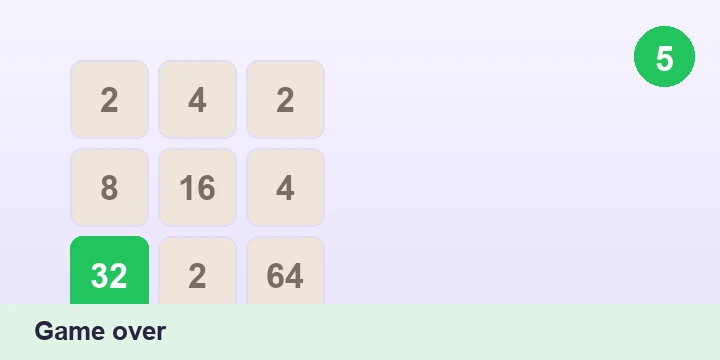
Game over
The game ends when the grid is full and no two neighbours share a number, so no merge is possible. Your score is the sum of every merge you made.
Where 2048 came from
2048 was created over a single weekend in March 2014 by Gabriele Cirulli, then a nineteen-year-old developer in Italy. He built it partly to see whether he could program a game from scratch, and released it for free on the web with the source code open for anyone to study.
The game was not wholly original: it was a direct riff on a clone called 1024, which itself borrowed from the polished mobile game Threes. Cirulli's version simplified the merging rule to powers of two and, crucially, made it instantly playable in any browser with the arrow keys.
Within a week it had been played hundreds of millions of times and spawned countless variants - hexagonal boards, higher targets, Fibonacci merges and more. Its blend of one-sentence rules and a genuinely deep endgame turned 2048 into one of the defining casual puzzles of the 2010s.
Tips to solve 2048 faster
💡 Best move: Pick one corner as home and keep your biggest tile locked there - build the whole board around that anchor and never let it move.
- Choose two 'safe' directions and lean on them; only swipe toward your anchor's row and never make the swipe that would drag the big tile out of its corner.
- Build your top values into a descending staircase along one edge so equal tiles line up ready to merge in a chain.
- Keep the row next to your anchor stocked with feeder tiles, so a single swipe zips a whole cascade of merges together.
- Merge small tiles early and often - a cluttered board of stranded 2s and 4s is what kills a run, so clear them before they pile up.
- Slow down near the end. When the board is nearly full, read every tile before you swipe, because one forced move in the wrong direction can end the game.
Sharper tactics for 2048
- Treat the fourth direction as forbidden. Disciplined players effectively play with three swipe directions and only use the fourth when there is literally no other legal move.
- Set up merge chains: line up 2-4-8-16 in sequence so that one push collapses the entire run into the next power of two in a single turn.
- Watch where new tiles can appear. Keeping one edge full limits the spawn zone and stops a stray 2 from landing in the middle of your staircase.
- When forced off your safe directions, choose the swipe that disturbs your ordered edge the least, then immediately rebuild it on the next move.
- On the 3×3 board, reaching 2048 is genuinely hard because space is so tight - prioritise merges over building and accept a lower ceiling.
Mistakes that trip people up
- Swiping in all four directions freely - pick a corner and two safe directions, and treat the fourth swipe as a last resort that scatters your big tiles.
- Chasing the largest merge every turn while your small tiles pile up - clear stray 2s and 4s early before they choke the board.
- Letting your biggest tile drift out of its corner - build the whole board around that anchor and never make the move that drags it away.
- Playing fast when the grid is nearly full - read every tile first, because one careless swipe at the end ends the whole run.
Ways to play 2048
Classic 4×4
The original sixteen-cell board where 2048 is a satisfying but reachable goal for a careful player.
Tight 3×3
A cramped nine-cell grid where space vanishes quickly and every merge has to be planned - a real test even for veterans.
Roomy 5×5
A generous twenty-five-cell board that gives your staircase room to breathe and makes chasing 4096 and beyond realistic.
Number-merge cousins
Games like Threes, 1024 and Fibonacci-merge boards share the slide-and-combine idea with different merge rules and targets.
2048 questions, answered
Do you win 2048 when you reach the 2048 tile?
Yes - creating a tile that shows 2048 is the official win, and most versions congratulate you at that moment. On Puzzle.now you can then choose to keep going and push for 4096 or higher until the board finally deadlocks.
What is the highest tile possible in 2048?
On the standard 4×4 board the theoretical maximum is the 131072 tile, though reaching even 8192 is a serious achievement. Larger boards raise the ceiling and smaller boards lower it.
Is 2048 luck or skill?
Mostly skill. The only random element is whether each new tile is a 2 or a 4 and where it lands, but a consistent corner strategy will reach 2048 far more often than random swiping, which proves planning dominates luck.
Why did my move do nothing?
A swipe only counts if at least one tile actually moves or merges. If every tile is already pressed against that wall with no available merges, the board stays put and no new tile spawns - you simply have to pick a different direction.
What is the best corner strategy?
Choose a corner, keep your largest tile there, and build a descending line of values along the edge leading away from it. Restrict yourself to the two swipe directions that feed the corner, and you protect your progress from being scattered.
Can 2048 be unwinnable from the start?
No single board is doomed from the opening, but poor play makes deadlock inevitable. The game ends only when the grid is completely full and no two adjacent tiles match, a state you reach through your own moves rather than a bad deal.
Where did the game 2048 come from?
It was written in 2014 by Gabriele Cirulli, a 19-year-old Italian developer, as a weekend project built on the earlier games 1024 and Threes. He released it free and open source, and it went viral within days.
Still curious about 2048? Browse the full puzzle FAQ, look up a term such as sliding puzzle in the puzzle glossary, or compare 2048 with the other games in the rules for every puzzle.
Last updated .